In this series
Krishna & Diwali: The Story of Narakasura and Sacred Art for Your Home

Most people associate Diwali with Goddess Lakshmi and the return of Lord Rama to Ayodhya. Yet there is a third major mythological event woven into the fabric of Diwali — one that is central to the celebration in South India, Maharashtra, and among Vaishnava communities worldwide: the victory of Lord Krishna over the demon Narakasura.
This story, observed on Naraka Chaturdashi (the day before Diwali proper), illuminates a different dimension of the festival — one of cosmic battle, divine protection, and the triumph of the sacred feminine alongside Krishna. Understanding it enriches the entire Diwali experience and reveals why Krishna belongs in your Diwali mandir.
The Story of Narakasura
Narakasura was the son of the earth goddess Bhudevi and Lord Vishnu in his Varaha avatar. Born of this divine union, he was granted the boon that he could only be killed by his own mother — a condition that seemed to guarantee his invincibility.
Over time, Narakasura became drunk with power. He conquered the heavens, defeated Indra, imprisoned sixteen thousand daughters of gods and sages in his palace, and stole the divine earrings of Aditi. Aditi appealed to Lord Vishnu for protection. Krishna took up the battle, bringing his consort Satyabhama — who was Bhudevi reborn — alongside him.
In the great battle that followed, it was Satyabhama — Narakasura’s own mother — who delivered the killing blow. The demon’s own boon became his undoing. Before dying, Narakasura asked that his death be celebrated with joy rather than mourned. Krishna granted this request. The sixteen thousand imprisoned women were freed and, in an act of extraordinary compassion, Krishna restored their honor and dignity.
Why This Story Matters for Diwali
The story of Narakasura carries layers of significance that resonate with Diwali’s core themes:
- Light over darkness: Narakasura’s defeat freed the world from a great darkness — the people lit lamps to celebrate, just as they did after Rama’s return
- The power of the sacred feminine: Satyabhama’s role is essential — it took the goddess in her earthly form to complete the victory, reflecting the Hindu understanding of Shakti as the active force that makes divine intention manifest
- Compassion over conquest: Krishna’s restoration of the sixteen thousand women’s dignity is central — the victory is incomplete without the liberation and compassion that follow
Naraka Chaturdashi: The Day of Krishna’s Victory
Naraka Chaturdashi falls on the fourteenth day of Krishna Paksha in Kartik month — the day before Diwali’s main night. In 2026, this falls on October 26.
In South India and Maharashtra, Naraka Chaturdashi is observed with great festivity. Traditions include:
- Pre-dawn oil bath (Abhyanga Snanam): Waking before sunrise for a ritual bath with sesame oil, symbolizing purification. It is said that taking this bath before the sun rises grants the merit of bathing in the Ganga
- Bursting crackers at dawn: Symbolizing the great battle between Krishna and Narakasura
- Preparing sweets: Especially in Maharashtra, special sweet preparations are distributed to neighbors and family
- Krishna puja: Worship of Krishna and Satyabhama together, honoring the divine pair whose victory brought liberation and light

Krishna in the Vaishnava Diwali Tradition
For Vaishnava communities, Diwali has a distinctly Krishna-centered dimension. Many Vaishnava families also observe:
- Govardhan Puja (the day after Diwali) — celebrating Krishna’s lifting of Govardhan Hill to protect the people of Vrindavan from Indra’s wrath
- Annakut (mountain of food) — an elaborate offering of food to Krishna, celebrating abundance and gratitude
- Recitation of the Bhagavata Purana during the festival season, with particular attention to the Narakasura narrative in the Tenth Canto

Krishna’s Iconography: What to Look for in Sacred Art
For those wishing to honor Krishna in their Diwali mandir, understanding his iconographic attributes ensures correct sacred representation:
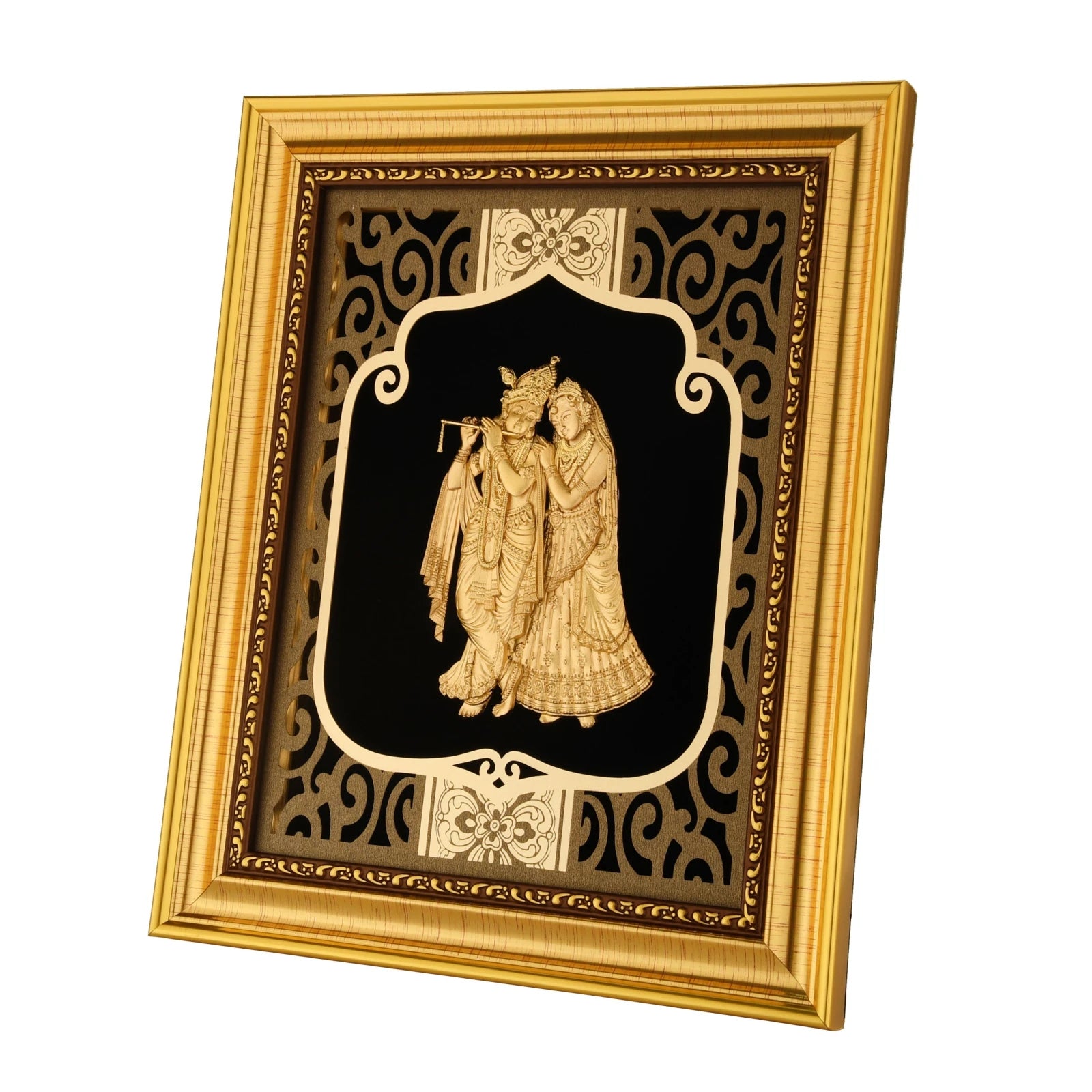
- The flute (Murali): Krishna’s most distinctive attribute — he plays it to call his devotees, as the divine calls the soul toward liberation
- Peacock feather (Mora Pankha): Worn in his crown, associated with beauty, grace, and divine play (lila)
- Yellow dhoti (Pitambara): Signifying his divine royalty and the solar quality of his nature
- Tribhanga posture: The characteristic triple-bent stance that conveys the relaxed grace of divine play

Placing Krishna in Your Diwali Mandir
For the Diwali festival season, Krishna can be honored in your mandir in several ways:
- Alongside Lakshmi and Ganesha: A three-deity altar honoring all major Diwali deities; appropriate for families with both Shaiva-Shakta and Vaishnava traditions
- As the primary deity: For Vaishnava families, Krishna or Radha Krishna at the center, with other deities in supporting positions
- As a dedicated Govardhan Puja altar: A Krishna image surrounded by food offerings on the day after Diwali
Explore our Krishna gold foil paintings — each rendered with iconographic accuracy and the warm luminosity of genuine 24K gold, worthy of the deity whose compassion and divine play illuminate the darkest night.
The Light That Krishna Brings
Diwali’s many stories — Rama’s return, Lakshmi’s blessing, Krishna’s victory over Narakasura — are not competing narratives. They are facets of a single truth: that the divine, in all its forms, is ultimately a force of light overcoming darkness, of liberation overcoming captivity, of grace overcoming tyranny.
Whether your family’s Diwali centers on Lakshmi, Rama, or Krishna, the festival invites you to place that divine light at the center of your home — in your mandir, in your prayers, in the sacred art you choose to anchor your sacred space.
Om Namo Bhagavate Vasudevaya. May Krishna’s light illumine your home this Diwali and always.