In this series
Ganesha Before Lakshmi: Why Ganesh Puja Opens Every Diwali Ritual

Every Diwali puja begins the same way — with Ganesha. Before the diyas are lit for Lakshmi, before the coins are arranged, before the Lakshmi Chalisa is recited, Ganesha is invoked first. This is not a matter of preference or regional custom. It is a theological principle embedded so deeply in Hindu ritual practice that it holds across traditions, lineages, and sectarian boundaries.
But why? Why does the god of new beginnings take precedence over the goddess of wealth on the very night dedicated to Lakshmi? The answer reveals something profound about the architecture of Hindu sacred thought — and about the complementary relationship between these two great deities.
The Theological Foundation: Vighnaharta
Ganesha’s primary title is Vighnaharta — the remover of obstacles. His complementary title is Vighnakarta — the creator of obstacles. Both titles are equally important, and together they reveal Ganesha’s unique cosmic function.
Ganesha does not simply remove obstacles on request. He governs the very principle of obstruction and its removal. He controls the threshold between intention and manifestation — the point at which a venture either takes form or fails to materialize. This is why he is invoked at the beginning of every significant undertaking: not because he will necessarily remove all difficulties, but because without his blessing, the undertaking itself cannot properly begin.
Diwali Lakshmi Puja is, in essence, an invitation — an attempt to draw Lakshmi’s presence and blessing into the home. As an undertaking, it requires a clear threshold, an unobstructed path. Ganesha must be invoked first to ensure that the invitation itself is free of impediment — that Lakshmi can actually enter.
The Mythological Basis: Ganesha and the Primacy Question
The supremacy of Ganesha in ritual order has a direct mythological origin. According to the Shiva Purana and several other texts, the gods once gathered to determine who among them should be worshipped first in all rituals. Different divine camps advocated for different candidates based on their respective powers and domains.
Lord Shiva settled the question with a test: whichever deity could circumnavigate the entire universe first would receive the honor of being worshipped first in all future rituals. While most of the gods raced off on their vehicles, young Ganesha simply walked around his parents, Shiva and Parvati, three times.
When asked to explain himself, Ganesha said: “For a devoted son, his parents are the entire universe.” Shiva declared him the winner and granted him the boon of Agrapuja — the right to be worshipped first in all rituals, by all beings, for all time.
This boon is unconditional. It applies to Diwali puja exactly as it applies to a wedding ceremony, a business inauguration, or a temple consecration. Ganesha goes first. Always.

Ganesha and Lakshmi: Complementary, Not Competing
It would be a mistake to read Ganesha’s primacy as a hierarchy of importance. In the context of Diwali, Ganesha and Lakshmi are not competing for prominence — they are completing each other.
Consider what each deity represents:
- Ganesha — the capacity to begin, to clear the path, to remove what stands between intention and manifestation
- Lakshmi — the abundance that flows in once the path is clear; prosperity, grace, and material and spiritual wealth
Together, they form a complete theology of prosperity: first, remove the obstacles (Ganesha); then, welcome the abundance (Lakshmi). One without the other is incomplete. This is why the image of Lakshmi Ganesh — the two deities depicted together — is among the most beloved and widely displayed sacred images in Hindu homes.

Regional Variations in the Puja Sequence
While the principle of Ganesha first is universal, the specific form varies by tradition and region:
- North Indian tradition: Brief Ganesha vandana and flower offering before the main Lakshmi puja begins
- South Indian tradition: More elaborate Ganesha puja, sometimes including a separate Ganesha idol placed to the right of Lakshmi on the altar
- Maharashtrian tradition: Ganesha is considered the primary deity of the household in many families; his puja on Diwali is performed with particular attention
- Gujarati tradition: Ganesha is invoked with specific mantras before Lakshmi puja begins; the image of Lakshmi Ganesh is particularly prominent
Ganesha Mantras for Diwali
At the opening of Diwali puja, Ganesha is typically invoked with one or more of these mantras:
Vakratunda Mahakaya:
Vakratunda mahakaya suryakoti samaprabha
Nirvighnam kuru me deva sarva-karyeshu sarvadaO Lord with the curved trunk and mighty body, whose radiance equals a million suns — remove all obstacles from my endeavors, always and in all things.
Om Gam Ganapataye Namaha — the seed mantra of Ganesha, chanted 3, 11, or 108 times to invoke his presence before the puja begins.
Choosing Sacred Art for Ganesha in Your Diwali Mandir
Given Ganesha’s essential role in Diwali ritual, having a dedicated and beautiful Ganesha image in your mandir — as a co-presence alongside Lakshmi — is both theologically appropriate and aesthetically powerful.
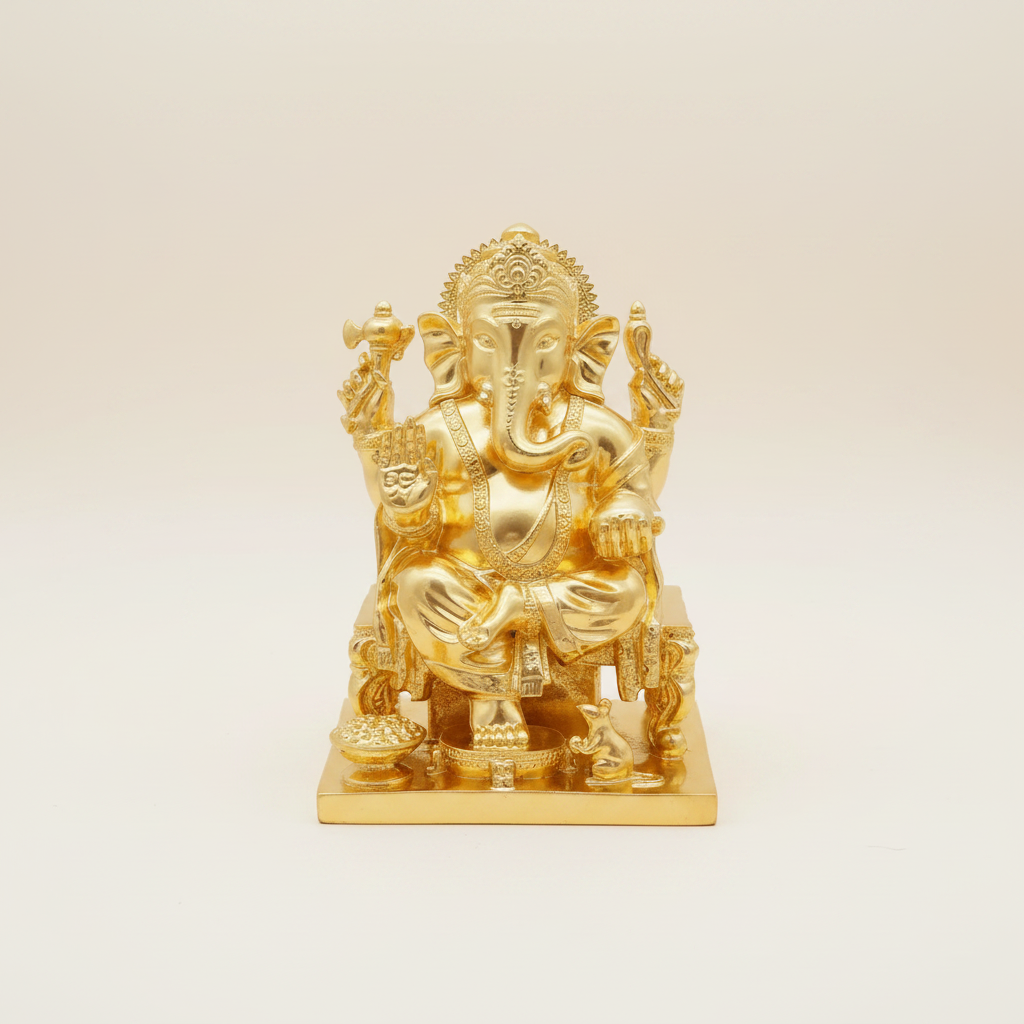
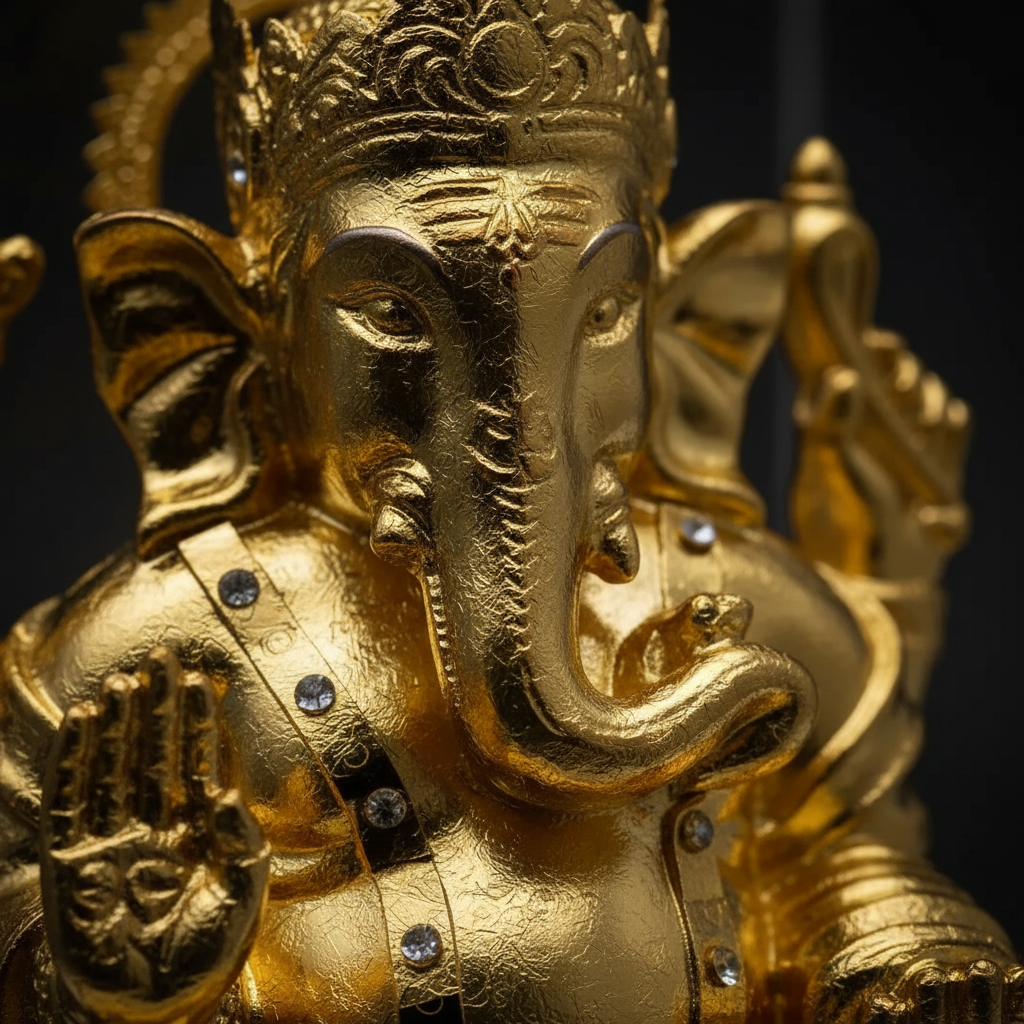
In gold foil art, Ganesha is depicted with his traditional attributes: the elephant head (wisdom and discernment), single tusk (sacrifice for knowledge), modak (sweetness of liberation), mouse vahana (mastery of desire), and abhaya mudra (protection and blessing).
For Diwali, place Ganesha to the right of Lakshmi from the viewer’s perspective. The two deities together create the complete Diwali puja altar — obstacle removal and abundance, beginning and fulfillment, the path cleared and the blessing flowing.

Explore our Ganesha gold foil paintings and sacred statues — each rendered with iconographic care and genuine 24K gold foil, worthy of the deity who opens every sacred beginning.
A Final Reflection: Why Order Matters in Ritual
The sequence of a puja is not arbitrary. Ritual order encodes theology — it teaches, through action, the relationships between divine principles. When we invoke Ganesha before Lakshmi, we are enacting a truth: that prosperity flows most freely when the path is first made clear, that abundance follows readiness, that the divine enters when we have properly prepared the way.
This Diwali, honor both deities with the fullness of their meaning. Begin with Ganesha — the remover of obstacles, the lord of beginnings. Then welcome Lakshmi — the goddess whose grace, once the path is open, flows without end.
Om Gam Ganapataye Namaha. Om Shreem Mahalakshmyai Namaha.