
In this series
Singing the Song of God: A Complete Guide to the Bhagavad Gita
Summary
The Bhagavad Gita — the "Song of God" — is the most beloved and widely read spiritual text in the Hindu tradition, and one of the most influential philosophical works in the history of the world. Embedded in the Mahabharata's Bhishma Parva, it records the divine conversation between Lord Krishna and the warrior Arjuna on the battlefield of Kurukshetra — a conversation that encompasses the entire range of human spiritual aspiration and offers a complete guide to living a life of meaning, purpose, and liberation.
The Setting: Kurukshetra

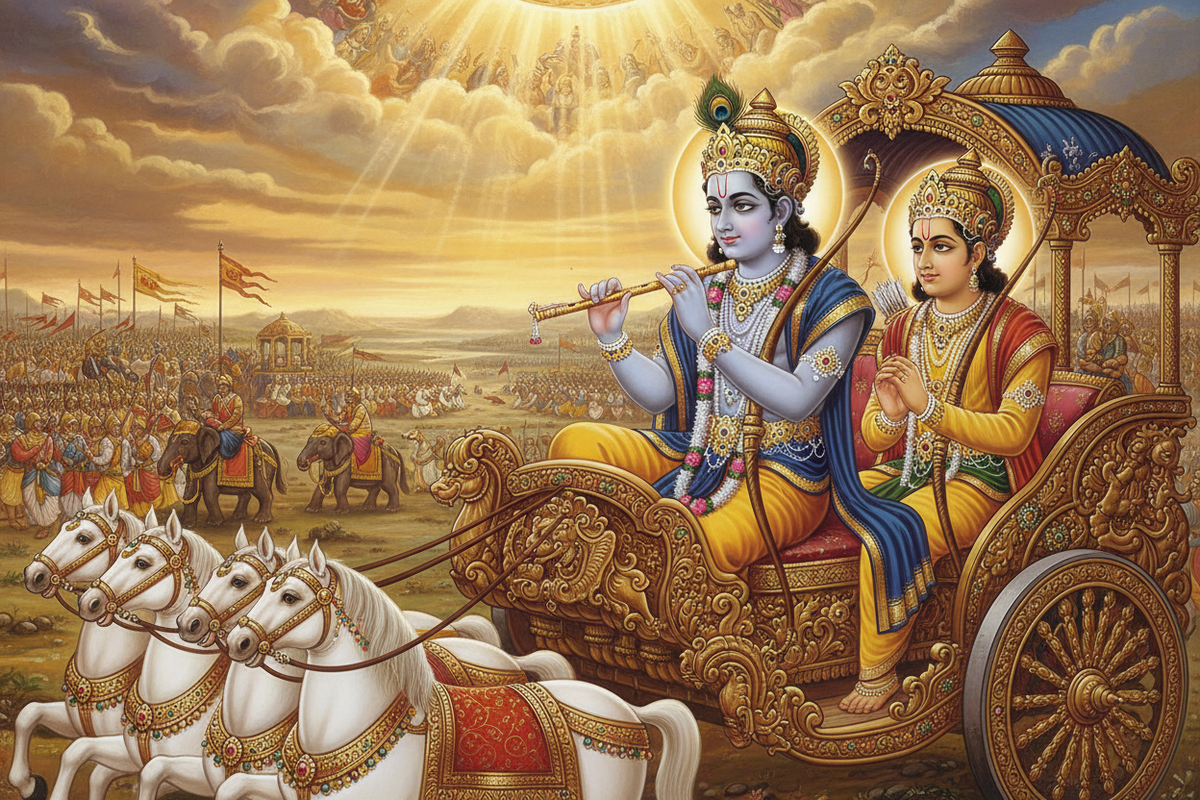
The Bhagavad Gita begins at the most dramatic moment imaginable: two armies face each other on the battlefield of Kurukshetra, ready for the decisive battle of the Mahabharata war. Arjuna — the greatest warrior of his age — looks across the battlefield and sees his teachers, uncles, cousins, and friends arrayed against him. Overwhelmed by grief and confusion, he drops his bow and refuses to fight. It is at this moment of complete collapse that Lord Krishna — Arjuna's charioteer and closest friend — begins the teaching that becomes the Bhagavad Gita.
The Three Paths to Liberation
| Path | Sanskrit | Teaching | For Whom |
|---|---|---|---|
| The Path of Action | Karma Yoga | Perform all actions as an offering to God, without attachment to results; "You have a right to perform your prescribed duties, but you are not entitled to the fruits of your actions" (2.47) | Those of active temperament |
| The Path of Devotion | Bhakti Yoga | Love God with complete devotion; surrender all actions, thoughts, and desires to the divine; "Fix your mind on Me, be devoted to Me, worship Me, bow down to Me. So shall you come to Me" (9.34) | Those of devotional temperament |
| The Path of Knowledge | Jnana Yoga | Discriminate between the eternal Self (Atman) and the temporary body-mind; realize your identity with Brahman; "The wise grieve neither for the living nor for the dead" (2.11) | Those of intellectual temperament |
Krishna's Cosmic Vision: The Vishvarupa

The climax of the Bhagavad Gita is the 11th chapter, in which Krishna reveals his Vishvarupa — his cosmic universal form — to Arjuna. Arjuna sees the entire universe contained within Krishna's body: all the gods, all the worlds, all of time past, present, and future. Overwhelmed with awe and terror, Arjuna begs Krishna to return to his familiar human form. This vision is the Gita's most direct statement of its central teaching: that the divine is not separate from the world but is the very substance of all existence.
Key Teachings of the Bhagavad Gita
- Selfless action (Nishkama Karma) — act without attachment to results; offer all actions to God
- The eternal Self (Atman) — the soul is eternal, indestructible, and beyond birth and death
- Inner renunciation — true renunciation is the renunciation of desire and ego, not of action itself
- Dharma — each person has a specific duty (Svadharma) that must be performed with full commitment
- Surrender (Prapatti) — "Abandon all varieties of dharma and simply surrender unto Me. I shall deliver you from all sinful reactions; do not fear" (18.66)
The Gita's Influence
The Bhagavad Gita has inspired some of the greatest minds in history. Mahatma Gandhi called it his "eternal mother" and read from it daily. Henry David Thoreau kept it by his side at Walden Pond. J. Robert Oppenheimer quoted it at the first nuclear test: "Now I am become Death, the destroyer of worlds." Swami Vivekananda, Sri Aurobindo, and countless other spiritual masters have written commentaries on it. Its teaching of selfless action, inner freedom, and the unity of all existence speaks to the deepest aspirations of the human heart — across all cultures, all times, and all traditions.
Conclusion
The Bhagavad Gita is not merely a religious text — it is a complete guide to the art of living: how to act without being enslaved by results, how to love without being destroyed by loss, how to face the most extreme circumstances with equanimity and courage, and how to recognize the divine in every moment of ordinary life. To read the Gita is to enter into conversation with the divine itself — and to receive, in 700 verses, the complete answer to the question that every human being carries in their heart: "How shall I live?"
"Sarvadharman parityajya mam ekam sharanam vraja" — "Abandon all varieties of dharma and simply surrender unto Me." (Bhagavad Gita 18.66)
This article is part of Moksha Craft's Sacred Knowledge Series — handcrafted in India, delivered worldwide.

