
In this series
Goddesses from the Vedas: Prithvi, Ushas & Ratri — The Divine Feminine in the Rigveda
Summary
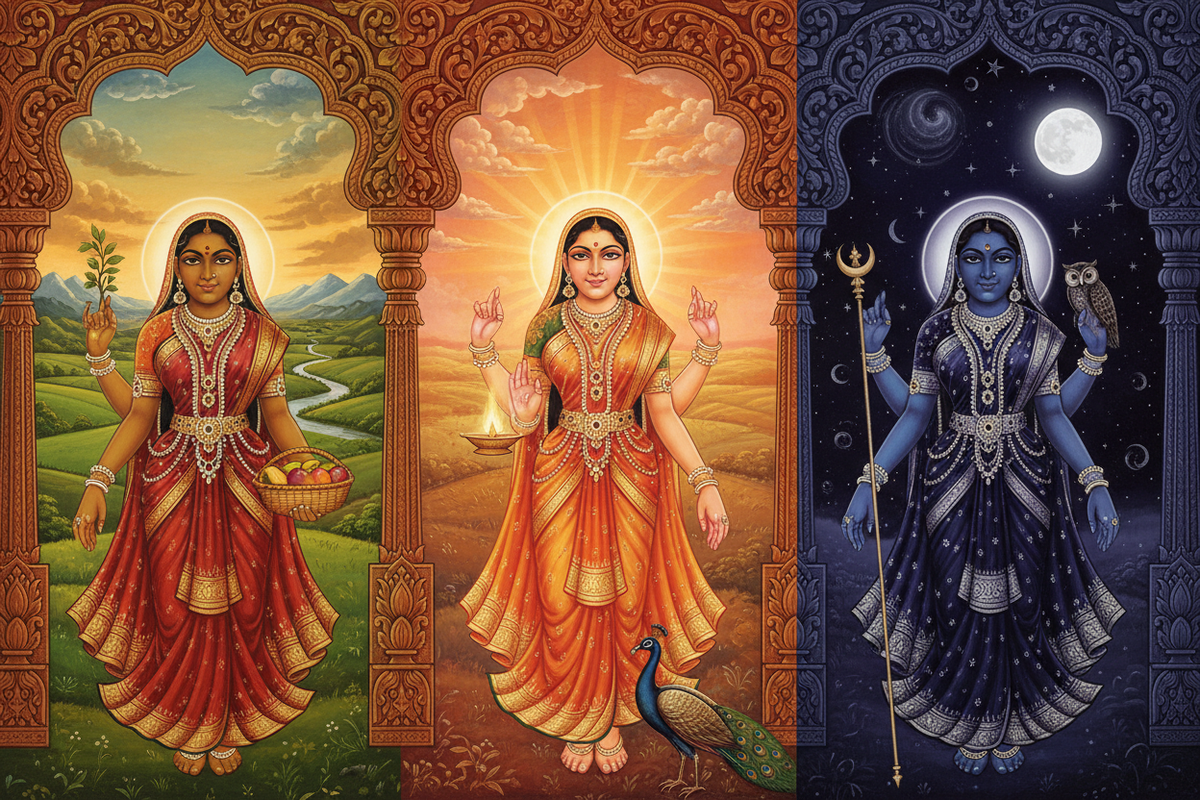
The Rigveda — the oldest of the four Vedas and the oldest religious text in continuous use in the world — celebrates a rich pantheon of divine beings, including several powerful goddesses who embody the fundamental forces of nature and cosmic order. Among the most important are Prithvi (the earth), Ushas (the dawn), and Ratri (the night) — three goddesses who together represent the feminine dimension of the Vedic cosmos.
The Three Great Vedic Goddesses

| Goddess | Domain | Sanskrit Meaning | Key Qualities |
|---|---|---|---|
| Prithvi | Earth | "The broad one" | Universal mother, sustainer of all life, manifest matter, stability |
| Ushas | Dawn | "The shining one" | Cosmic order (Rita), renewal, light, the gateway between night and day |
| Ratri | Night | "The dark one" | Rest, protection, the sister of Ushas, the complement of dawn |
Prithvi: The Earth Mother
Prithvi — the earth goddess — is one of the most ancient and fundamental divine presences in the Vedic tradition. As the universal mother who sustains all life, she is celebrated in the Rigveda as the foundation of all existence: "O Earth, my mother, set me securely with bliss in full accord with heaven. O wise one, uphold me in grace and splendor." (Atharva Veda 12.1)
Prithvi is often paired with Dyaus (the sky father) as the primordial divine couple — the cosmic parents whose union generates all of existence. Together, Dyaus-Prithvi represent the fundamental polarity of heaven and earth, masculine and feminine, transcendence and immanence.
Ushas: The Dawn Goddess

Ushas is the most celebrated goddess in the Rigveda — with over 20 hymns dedicated to her, more than any other goddess. She is the goddess of the dawn — the rosy light that appears on the eastern horizon each morning, dispelling the darkness of night and ushering in a new day. In the Vedic tradition, Ushas is not merely a natural phenomenon but a divine being who upholds Rita (cosmic order) — the fundamental principle of truth and righteousness that governs the universe.
"She, the daughter of the sky, has appeared — the young woman, robed in light. She has opened the darkness as a cow opens the stable door. She has driven away the evil spirits of the night." (Rigveda 1.92)
Ratri: The Night Goddess
Ratri — the goddess of night — is the sister and complement of Ushas. While Ushas brings light and activity, Ratri brings rest, protection, and the deep silence in which the soul can renew itself. The Rigveda's Ratri Sukta (10.127) is one of the most beautiful hymns in the entire Vedic corpus — a prayer to the night goddess for protection from the darkness and its dangers:
"The goddess Night has drawn near, looking about on many sides with her eyes. She has put on all her glories. The immortal goddess has filled the wide space, the depths and the heights." (Rigveda 10.127.1)
Conclusion
Prithvi, Ushas, and Ratri represent the oldest layer of the Hindu goddess tradition — divine feminine presences who embody the fundamental forces of nature and cosmic order. To contemplate these goddesses is to connect with the most ancient stratum of human religious experience — the awe and reverence with which our ancestors greeted the earth beneath their feet, the dawn that ended the night's darkness, and the night that brought rest and renewal. These are not merely mythological figures but living presences — the divine feminine in her most elemental and universal forms.
This article is part of Moksha Craft's Sacred Knowledge Series — handcrafted in India, delivered worldwide.

