In this series
The Peacock in Hindu Symbolism: Grace, Protection & Sacred Beauty

The peacock is India’s national bird — but long before it became a symbol of the Indian nation, it was a sacred presence in Hindu, Buddhist, and Jain traditions spanning thousands of years. In Hindu iconography, the peacock is not decorative background. It is a layered symbol carrying meanings of divine grace, protection, cosmic beauty, and spiritual victory — meanings that make peacock art one of the most versatile and universally resonant forms of sacred imagery for the home.
This guide explores the complete symbolism of the peacock in Hindu tradition — its divine associations, its mythological significance, and why a peacock in 24K gold foil is among the most powerful and accessible sacred art choices for any home.
The Peacock and Lord Murugan (Kartikeya)
The most direct divine association of the peacock in Hindu tradition is with Lord Murugan — also known as Kartikeya, Skanda, Subramanya, and Kumara. Murugan is the son of Shiva and Parvati, the commander of the divine army, and one of the most widely worshipped deities in South Indian tradition.
Murugan’s vahana (divine vehicle) is the peacock — specifically the peacock named Paravani. The choice carries precise theological meaning:
- Victory over the serpent: Peacocks are known to kill and eat snakes. In Hindu symbolism, the serpent represents ego, desire, and the poison of ignorance. Murugan’s peacock trampling the serpent represents the victory of divine wisdom over the ego’s poisons
- Beauty from poison: Peacocks are believed to consume snake venom and transform it into the iridescent beauty of their plumage — a symbol of spiritual alchemy, the transformation of life’s difficulties into something radiant
- Rain and renewal: Peacocks dance at the arrival of monsoon rains, associating them with abundance, renewal, and nature’s generosity

The Peacock and Lord Krishna
Lord Krishna’s most iconic adornment is the peacock feather worn in his crown — the Mora Pankha. In the Vrindavan forest, peacocks danced when Krishna played his flute, and one peacock offered him its feather as a gift of devotion. Krishna accepted it and wore it ever after as a symbol of the pure offering of a devoted heart.
The peacock feather in Krishna’s crown carries multiple layers of meaning:
- Divine beauty: The peacock’s eye-spotted tail represents the all-seeing quality of the divine — Krishna’s awareness that encompasses all things
- The gift of devotion: The peacock’s free offering of its feather represents the ideal of bhakti — the spontaneous, joyful offering of the self to the divine
- Lila (divine play): Peacocks dancing to Krishna’s flute is one of the most beloved images of Vrindavan’s divine lila — the blissful interaction between the divine and all of creation
The Peacock and Goddess Saraswati
Goddess Saraswati — the goddess of knowledge, arts, and wisdom — is sometimes depicted with a peacock as her vahana in certain regional traditions. The peacock’s association with Saraswati emphasizes its connection to beauty, artistic excellence, and the refinement of perception — the ability to see the extraordinary within the ordinary, which is itself a form of wisdom.
The Peacock as a Universal Sacred Symbol
- Protection: The peacock’s ability to kill snakes makes it a natural guardian against evil and a protector of the home
- Auspiciousness: Its association with rain, abundance, and renewal makes it one of India’s most universally auspicious symbols across regional and religious traditions
- Immortality: Ancient traditions associated the peacock with immortality, making it a symbol of the eternal soul that survives the decay of the body
- Cosmic vision: The “eyes” in the peacock’s tail feathers — the ocelli — represent the cosmic eye of the divine, the all-seeing awareness that pervades creation
- Transformation: The peacock’s capacity to transform venom into beauty is one of the most potent transformation symbols in Hindu sacred thought — a direct analog to the spiritual path itself

Why Peacock Art Works for Every Home
Among all forms of sacred art, peacock imagery occupies a unique position: it is simultaneously deeply sacred and universally beautiful. This makes it the ideal choice for several contexts:
- Bicultural and NRI households: For Indian-heritage families in multicultural environments, peacock art communicates deep cultural and spiritual identity without requiring explanation to guests of other backgrounds
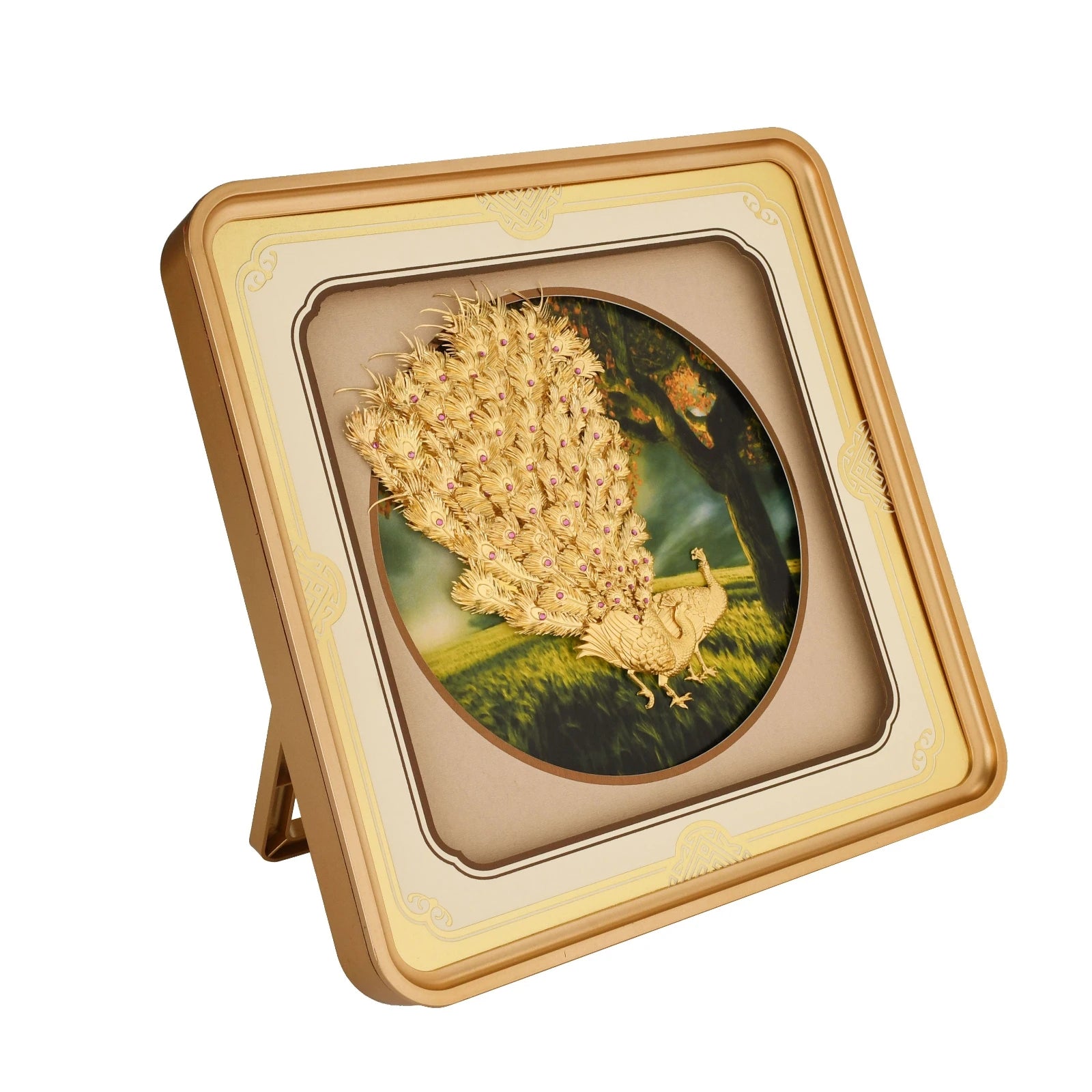
- Contemporary interiors: The peacock’s sweeping form and dynamic presence translates naturally into modern design contexts. A peacock gold foil painting at 11x11" becomes a statement piece that works equally well in a modern living room as in a traditional mandir corner
- Universal gifting: Peacock art is appropriate for recipients of any background — sacred meaning for those who understand it, pure beauty for those who simply appreciate extraordinary art
- Non-devotional sacred spaces: Not every room is a dedicated puja space, but every room can benefit from sacred beauty. The peacock’s layered symbolism makes it appropriate for living rooms, dining rooms, home offices, and entryways

The Peacock in 24K Gold Foil
The peacock’s natural iridescent colors — blue-green body, luminous eye-spots, the dynamic spread fan — are among the most visually complex in the natural world. Rendering this in 24K gold foil creates a fascinating transformation: chromatic complexity becomes tonal complexity, varied hues become varied textures of gold, iridescent shimmer becomes the shimmer of genuine metal catching light.
The result is simultaneously true to the peacock’s essential beauty and transformed into something uniquely sacred — the bird rendered in the most auspicious of metals, its natural radiance translated into the divine radiance of gold.
At 11x11 inches in a matte gold versatile frame, our Peacock gold foil painting is designed to be a statement piece — substantial enough to anchor a wall, refined enough to work in any aesthetic context, and layered enough in meaning to reward close attention.
Explore the Peacock 24K Gold Foil Painting — and bring one of India’s most sacred and beautiful symbols into your home.
May the peacock’s grace, protection, and sacred beauty illuminate every corner of your space.