
In this series
Myths, Monuments & Megaliths: India's Newest UNESCO World Heritage Nominees Explored
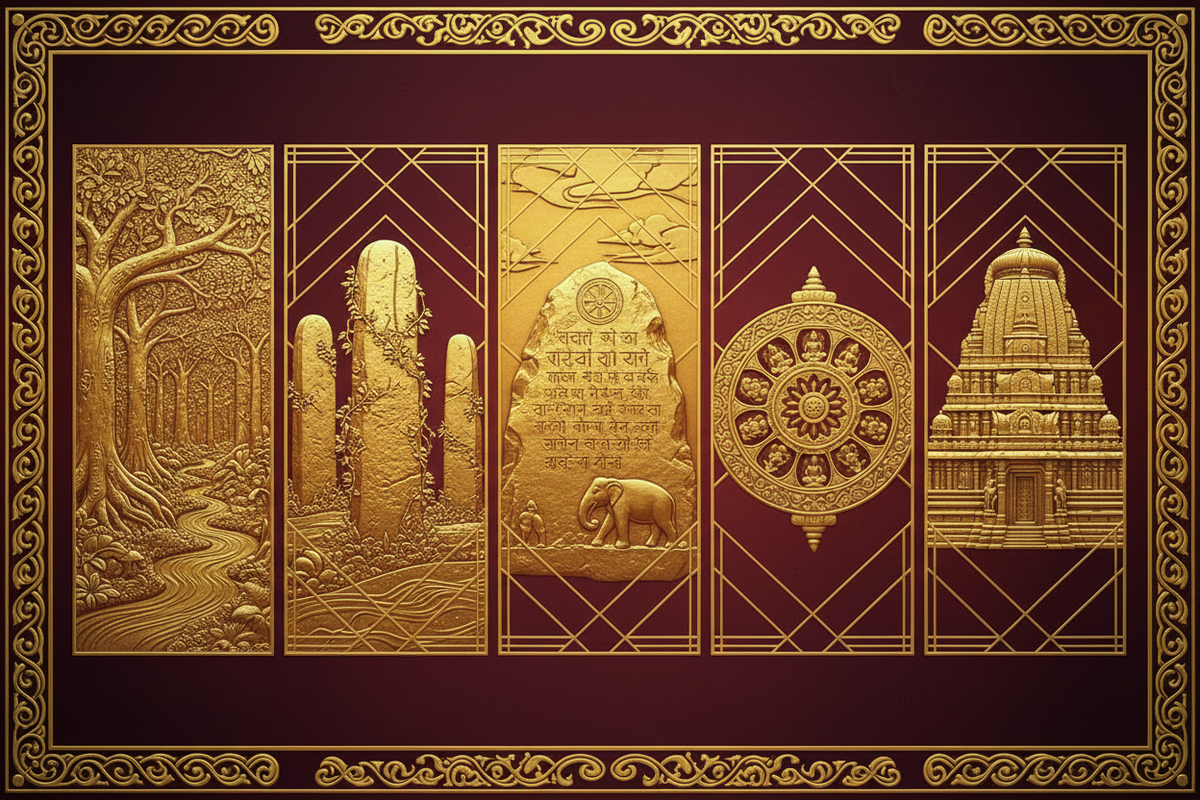
Summary
India's heritage is in the spotlight! Six awe-inspiring sites, from the mysterious Megaliths of Mudumal to the legendary Kanger Valley, have made it to UNESCO's tentative list of world heritage sites. What makes them extraordinary? How do Ashoka's edicts and Chausath Yogini temples fit in? Explore their stories, history, and significance and our role in preserving these cultural treasures.
Legends, Landmarks, and Megaliths: India's Latest Additions to UNESCO's Heritage List
Recently, 6 of India's ancient heritage sites were added to UNESCO's Tentative Heritage Sites. These include the Megaliths of Mudumal, Ashoka's rock edicts, sprawling Bundela palaces, and the naturally rich Kanger Valley National Park. But what makes these sites so special? What is UNESCO's tentative list? And most importantly, what can be our role in preserving our heritage? Let us start this journey of answering all these questions, starting with a closer exploration of these newest additions to UNESCO's list.

The Latest Indian Sites on the UNESCO Tentative List
Kanger Valley National Park in Chattisgarh, Mudumal Megalithic Menhirs of Telangana, Ashokan Edicts across various Indian states, Chausath Yogini temples in different parts of Central India, Gupta period temples in parts of Northern India, and fortresses of the Bundela rulers in Madhya Pradesh and Uttar Pradesh are a step closer to becoming UNESCO World Heritage sites.
The declaration was made in the first week of March, by the Permanent Delegation of India to UNESCO, Shri Vishal V. Sharma.
The UNESCO tentative list is like a nomination list of potential world heritage sites, submitted by the country to the organization. After considerations and deliberations over the value of the sites for the country, the world, UNESCO finalizes their place in the list of "World Heritage Sites".
Let us take a closer look at the intriguing aspects of the 6 sites, awaiting to be a part of this list-
Kanger Valley National Park (Chhattisgarh)
This national park was formally established in 1982, named after the river Kanger that flows through the land. The history of this region, however, goes back to the times of the Ramayana, when it was a part of Dandaka Forest or Dandakaranya, where Sri Rama stayed during his Vanvaas. A home to the Baiga and Gond tribes who are some of the oldest living tribal cultures, Kanger Valley houses Bastar Hill Mynah (the state bird of Chhattisgarh), Indian pangolin and naturally occurring limestone caves which make it a rare spot where humans and nature have co-existed and created collective heritage.
1. The Legend of Kanger River
The river that flows through this valley is a sacred mother to the local tribes — the Gonds and the Marias. Their folklore worships the Kanger Nadi as a heavenly goddess, who came to the human realm to shower abundance on the land and its people. Alternative narratives tell that Kanger was actually a divine river, who was cursed by gods and sent to the earth for the benefit of the tribes. For the locals, Kanger is as holy as the Ganga for Hindus worldwide.
2. Dandak Caves and the Ramayana Connection
The Kutumsar caves in the Kanger Valley region are associated with the ancient Dandaka-vana by the tribals who live in the area. According to their beliefs, when Rama, Lakshman, and Devi Sita came to the forest, these caves served as their homes, cradling them in their silent heart.
3. The Guardian Spirits of Kanger Valley
The local guardian spirits known as Bhumkas or Devs are worshipped by the tribes of Bastar as their ancient guardians. Many sacrificial rituals and festivals are celebrated in their honor, and the forests of Kanger Valley are seen as the home of these spirits.
4. The Mysterious 'Ghost Caves'
One of the deepest caves of the Kanger Valley, the Kailash cave is a mysterious place, worshipped and feared equally by the locals, whose folklores have given it a mythical status. People believe that these caves are the gateways to the spirits of their elders, the ancestors who live there, and use these caves as passages into the world of the living.
5. The 'Van Devi' – Goddess of the Forest
Indian traditions since the ancient period have worshipped the goddesses of the forest, known broadly as Van-Devi. In the Kanger valley, people worship her as their guardian and protector, who keeps an eye on the humans and animals alike.
Mudumal Megalithic Menhirs (Telangana)
Megaliths are gigantic stone monuments, dating back to the Iron Age, found all over the world. Often raised over a grave, they highlight a belief in marking the resting place, which is a sign of advanced cultural thinking, telling us about the richness of ancient societies. The Mudumal Megaliths are 3500–4000 year old structures, near the Krishna river.
1. Historical and Archaeological Significance
With around 80 menhirs (standing stones) all over the village, Mudumal is one of the most important Stone Age sites in India. One of the most intriguing elements of this site is the "sky maps" — drawings of the Ursa Major and Leo constellations on the rocks, which signify an understanding of astronomy among the Iron Age people of this region. Scholars believe the stones were located to record solstices and equinoxes as "calendar stones", underlining the use of celestial activities to measure time.
2. Cultural and Ritualistic Importance
The people of Mudumal village worship the Megaliths, especially one they call "Thimmappa Nirurallu" — Thimmappa of the Standing Stones. Interestingly, "Thimmappa" is a name used for Sri Venkateswara in parts of South India, meaning the locals see the massive stone as a representation of their beloved Tirupati Balaji. Tribal groups — Gonds and Koyas — also worship them as deities, ancestors, or guardian spirits.
3. The Need for Preservation
In addition to natural erosion, the Mudumal menhirs face danger from neglect and encroachment due to expanding agricultural lands. The nomination on UNESCO's tentative list is a crucial step in bringing global attention to this remote heritage site.
Ashokan Edict Sites along the Mauryan Routes
The edicts of Ashoka have gathered global recognition due to their contents and the vast geographical location they cover. Written in Prakrit, Greek, and Aramaic, these edicts are the first known official documents in India. Addressing elements of statecraft, administration, and Ashoka's Dhamma, 34 edicts have been chosen for the latest addition to UNESCO's tentative list.
1. Cultural and Educational Value
These edicts serve as symbols of ethical governance and social responsibility, providing contemporary societies with lessons on leadership, moral principles in statecraft, and the promotion of religious harmony.
2. Preservation Efforts
Inclusion in UNESCO's Tentative List brings international attention, increased funding, and conservation resources. The serial nomination of Ashokan Edict Sites along the Mauryan Routes represents a concerted effort to honor a legacy that has profoundly influenced Indian civilization.
Chausath Yogini Temples (Multiple States)
An inspiration behind the unique shape of the Indian Parliament, the Chausath or 64 Yogini Temples are sacred homes to Yoginis — potent aspects of the supreme goddess. While local traditions revered them as protecting goddesses, Hindu-Tantra worships Yoginis as incarnations of Durga. The temples date back to the 9th–12th Century CE, built by dynasties such as the Chandelas and Kalachuri rulers.
1. Historical and Architectural Significance
Architecturally circular or rectangular in design, with niches housing statues of the Yoginis, these temples are invaluable to the study of regional variation, religious architecture, sacred geometry, and the impact of Tantra on architecture.
2. Geographical Distribution
Approximately 13 such temples have been identified across India — eight in Madhya Pradesh (Khajuraho, Bhedaghat, Mitaoli, Dudhai, Badoh, Hinglajgarh, Shahdol, Naresar), and others in Odisha, Uttar Pradesh, and Tamil Nadu.
Gupta Temples in North India
Gupta period temples represent a mixing of Hindu, Buddhist, and Jain artistic elements — one of the first examples of free-standing religious architecture in India. Key features include a square sanctum (garbhagriha), a flat or shallowly curved roof, and simple ornamentation emphasizing symmetry and proportion.
Nachna-Kuthara Temple, Madhya Pradesh — 5th–6th century site featuring the Parvati temple and the four-faced Chaumukhanath Temple depicting the cosmic form of Mahadeva.
Bhitargaon Temple, Uttar Pradesh — The oldest surviving brick temple in India, with terracotta panels depicting scenes from the Hindu Puranas.
Dashavatara Temple, Deogarh — The first example of the Panchayatan style of architecture, famous for its depictions of Vishnu's ten incarnations.
Palace-Fortresses of the Bundelas
Built during the 16th–18th centuries, these palaces and fortresses showcase elements of Rajput and Mughal architectural styles. Notable structures include Garhkundar Fort, Raja Mahal and Jahangir Mahal in Orchha, Datia Palace (which inspired Edward Lutyens' design for Delhi), Jhansi Fort, and Dhubela Palace.
What is UNESCO?
UNESCO (United Nations Educational, Scientific and Cultural Organization) is a UN agency dedicated to safeguarding cultural heritage, encouraging sustainable development, and fostering global peace through knowledge-sharing and collaboration. Founded in 1945.
What is UNESCO's Tentative List?
An inventory of cultural and natural sites that a nation considers worthy of nomination for the World Heritage List. It is a preliminary step that allows UNESCO to assess a site's global significance before official nomination.
What is Serial Nomination?
A group of sites submitted together as part of a single World Heritage nomination, sharing a common theme, historical connection, or cultural significance — helping preserve cultural landscapes and interrelated monuments under a unified framework.
Conclusion: A Global Effort Is What Heritage Needs
The inclusion of these six sites in UNESCO's Tentative Heritage List is a call to action for preservation. Each site — whether the mystical Kanger Valley, the astronomical Megaliths of Mudumal, the Ashokan Edicts, or the sacred Chausath Yogini temples — is a unique representation of Indian and world culture. Preserving this heritage requires international collaboration, sustainable tourism, academic research, and public awareness.
This article is part of Moksha Craft's Sacred Knowledge Series — handcrafted in India, delivered worldwide.

