
In this series
Vishnu Purana: The Book of the Lord — A Complete Guide to the Vaishnava Scripture
Summary
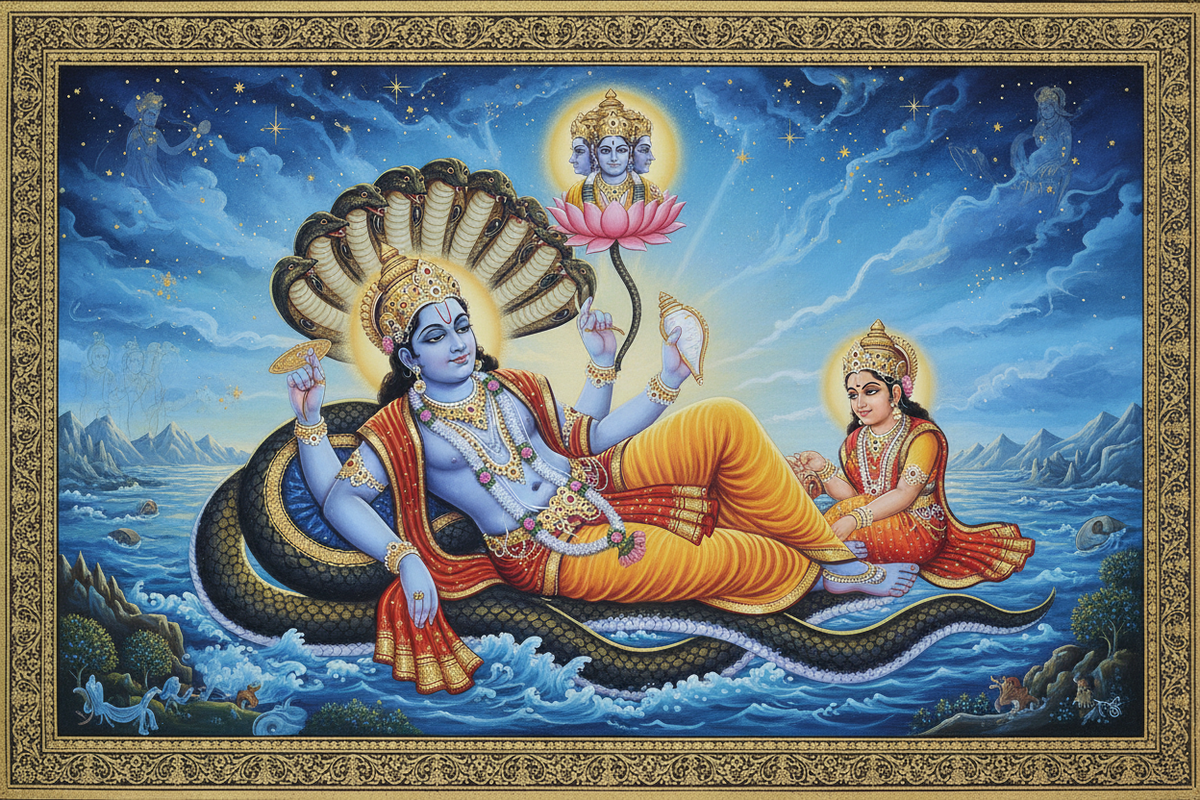
The Vishnu Purana is one of the eighteen Mahapuranas — the great encyclopedic scriptures of Hinduism — and is considered the most important and comprehensive of all the Puranas dedicated to Lord Vishnu. Composed in Sanskrit and attributed to the sage Parashara, it covers the complete range of Vaishnava theology: cosmology, genealogy, the nature of Vishnu, his incarnations, and the path to liberation through devotion. This guide explores the Vishnu Purana's structure, content, and significance.
The Vishnu Purana in Context

The eighteen Mahapuranas are the popular scriptures of Hinduism — vast encyclopedic texts that make the wisdom of the Vedas and Upanishads accessible to all devotees through stories, genealogies, cosmology, and devotional teaching. The Vishnu Purana is classified as a Sattvic Purana — one that promotes the qualities of purity, clarity, and spiritual aspiration — and is dedicated to Lord Vishnu as the supreme deity and the ultimate reality.
The Five Books of the Vishnu Purana
| Book | Sanskrit Name | Content |
|---|---|---|
| Book 1 | Sarga | Philosophical opening; the nature of Brahman, Vishnu, and creation; the four pralayas (cosmic dissolutions) |
| Book 2 | Pratisarga | Genealogical accounts of the Manus and the cosmic time cycles (Yugas and Kalpas) |
| Book 3 | Vamsha | Cosmography; the structure of the universe; the sacred geography of Bharata (India) |
| Book 4 | Manvantara | Genealogies of the solar and lunar dynasties; the lineages of the great kings and sages |
| Book 5 | Vamshanucharita | The complete biography of Lord Krishna — the most beloved section of the Vishnu Purana |
The Four Pralayas: Cosmic Dissolution
One of the most philosophically significant teachings of the Vishnu Purana is its description of the four types of cosmic dissolution (Pralaya):
- Naimittika Pralaya — the dissolution at the end of each Kalpa (day of Brahma); the three worlds are dissolved but the higher realms remain
- Prakritika Pralaya — the dissolution at the end of Brahma's life; all of creation returns to the primordial nature (Prakriti)
- Atyantika Pralaya — the individual's liberation (Moksha); the dissolution of the individual soul's identification with matter
- Nitya Pralaya — the continuous dissolution of each moment; the constant arising and passing away of all phenomena
Vaishnava Dharma in the Vishnu Purana
The Vishnu Purana's central teaching is Vaishnava Dharma — the path of devotion to Lord Vishnu as the supreme deity and the ultimate reality. It teaches that Vishnu is not merely one god among many but the Paramatman (supreme Self) — the infinite consciousness that underlies all of existence, from which all creation emerges and to which it all returns. Liberation (Moksha) is achieved through devotion (Bhakti), knowledge (Jnana), and righteous action (Karma Yoga) — all offered to Vishnu.
Conclusion
The Vishnu Purana is one of the most complete and authoritative expressions of Vaishnava theology in the Sanskrit tradition — a text that combines philosophical depth with devotional beauty, cosmic vision with intimate personal narrative. Whether you are drawn to its cosmological teachings, its genealogical accounts, or its beloved biography of Lord Krishna, the Vishnu Purana offers an inexhaustible treasury of Vaishnava wisdom.
This article is part of Moksha Craft's Sacred Knowledge Series — handcrafted in India, delivered worldwide.

