
In this series
Why Lord Shiva is Worshipped in Linga Form: The Sacred Meaning of the Shiva Lingam
Summary
The Shiva Lingam is the most sacred symbol in the Shaiva tradition — the form in which Lord Shiva is most widely worshipped across India and the world. But what does the Lingam actually represent? Why is the formless, infinite Shiva worshipped in this particular form? This guide explores the philosophical meaning of the Shiva Lingam, the stories behind its origin, and the rituals for its worship.
What is the Shiva Lingam?

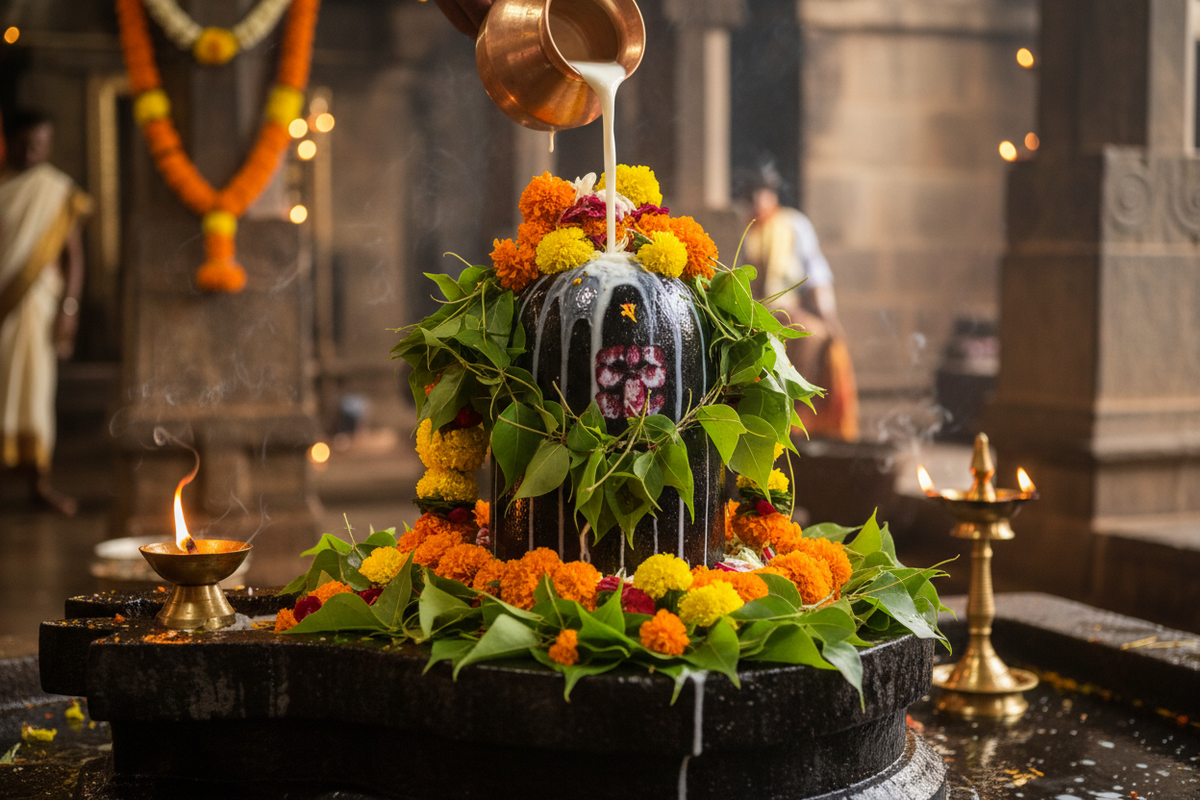
The word Lingam comes from Sanskrit, meaning "mark" or "symbol" — not a physical body part, as is sometimes mistakenly assumed. The Shiva Lingam is a symbol of the infinite, formless nature of Lord Shiva — the absolute consciousness that transcends all form, all duality, and all limitation. The Lingam rests on the Yoni (the base), which represents Goddess Parvati (Shakti) — together, the Lingam and Yoni symbolize the union of Shiva (consciousness) and Shakti (energy) that underlies all of creation.
The Story of the Infinite Fire Column
The most important story explaining the Shiva Lingam comes from the Shiva Purana. Once, Lord Brahma and Lord Vishnu were arguing about who was the greatest. Suddenly, an infinite column of fire (Jyotirlinga) appeared before them — stretching endlessly in both directions. Brahma took the form of a swan and flew upward to find the top; Vishnu took the form of a boar and dug downward to find the bottom. Neither could find the end. When they returned, Shiva appeared from within the column and declared: "I am the beginning and the end; I am the infinite; I am Brahman." The Lingam is the symbol of this infinite, beginningless, endless divine reality.
The 12 Sacred Jyotirlingas

| # | Jyotirlinga | Location |
|---|---|---|
| 1 | Somnath | Gujarat |
| 2 | Mallikarjuna | Andhra Pradesh |
| 3 | Mahakaleshwar | Ujjain, Madhya Pradesh |
| 4 | Omkareshwar | Madhya Pradesh |
| 5 | Kedarnath | Uttarakhand (Himalayas) |
| 6 | Bhimashankar | Maharashtra |
| 7 | Kashi Vishwanath | Varanasi, Uttar Pradesh |
| 8 | Trayambakeshwar | Maharashtra |
| 9 | Nageshwara | Gujarat |
| 10 | Baidyanath | Jharkhand |
| 11 | Rameshwaram | Tamil Nadu |
| 12 | Grishneshwar | Maharashtra |
How to Worship the Shiva Lingam at Home
- Purification — bathe and wear clean clothes; clean the puja space
- Abhishekam — pour water, milk, honey, curd, and Panchamrit over the Lingam
- Bilva leaves — offer three-leafed Bilva (Bel) leaves — the most sacred offering to Shiva
- Flowers — offer white flowers (especially Dhatura and Akanda)
- Mantra — chant "Om Namah Shivaya" 108 times or the Maha Mrityunjaya Mantra
- Aarti — perform aarti with a ghee lamp
Conclusion
The Shiva Lingam is not a primitive or crude symbol — it is one of the most philosophically sophisticated sacred symbols in the world, representing the infinite, formless nature of the divine in the most direct and powerful way possible. To worship the Lingam is to worship the infinite itself — to acknowledge that beyond all forms, all names, and all concepts, there is a reality that is beginningless, endless, and absolutely free.
"Om Namah Shivaya" — Salutations to Lord Shiva, the infinite consciousness.
Explore Moksha Craft's collection of handcrafted Shiva Lingams — made in India, delivered worldwide.

