
In this series
Who Is Wrathful Yama? The Buddhist King of Death & Guardian of Dharma Explained
Summary
Yama — the wrathful king of death — is one of the most powerful and symbolically rich figures in both Hindu and Buddhist traditions. In Buddhism, Yama is not merely a god of death but a profound spiritual symbol: the guardian of Dharma, the judge of karma, and the holder of the Wheel of Life (Bhavachakra) that depicts the entire cycle of existence. This guide explores Yama's role in Buddhist sacred art and philosophy.
Yama in Buddhist Tradition

| Tradition | Name | Role | Appearance |
|---|---|---|---|
| Tibetan Buddhism | Kalarupa / Dharmaraja | Dharmapala (protector of Dharma); judge of the dead | Fierce, dark blue or black, bull-headed, holding the Wheel of Life |
| Chinese Buddhism | Yanluo Wang | King of the ten courts of hell; judge of karma | Red-faced, wearing judge's robes and crown |
| Japanese Buddhism | Enma | Judge of the dead; ruler of the underworld | Fierce, red-faced, holding a staff and scroll of deeds |
| Pali Canon (Theravada) | Yama | King of the realm of the dead; not a judge but a witness | Described in the Devaduta Sutta as a divine messenger |
The Wheel of Life (Bhavachakra)
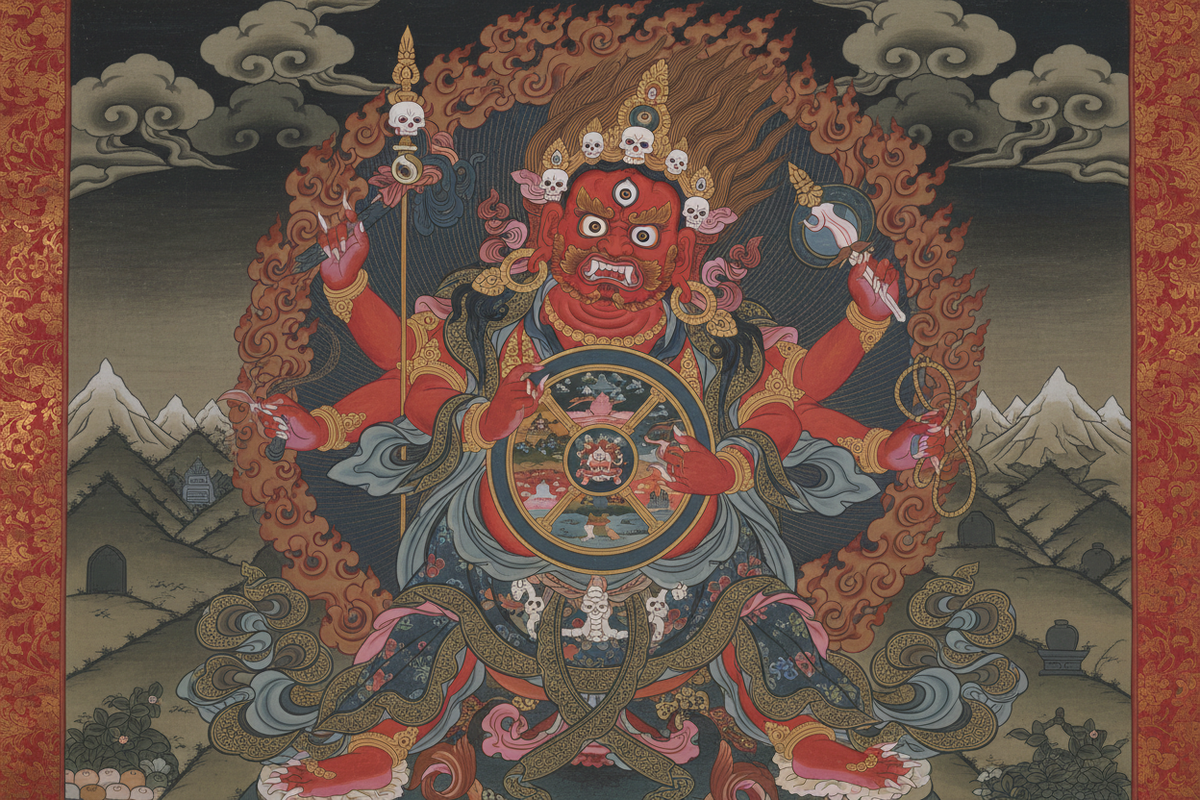
In Tibetan Buddhist iconography, Yama is most often depicted holding the Wheel of Life (Bhavachakra) — a complex diagram depicting the entire cycle of existence (samsara). The Wheel has six realms (gods, demi-gods, humans, animals, hungry ghosts, hell beings), twelve links of dependent origination around the rim, and three poisons (greed, hatred, delusion) at the center. Yama holds this wheel in his claws and teeth — symbolizing that death and impermanence are the framework within which all of samsaric existence occurs.
Yama as Dharmapala: Guardian of Dharma
In Tibetan Buddhism, Yama (as Kalarupa) is one of the most important Dharmapalas — wrathful protector deities who guard the Buddhist teachings and practitioners from obstacles and negative forces. His wrathful appearance is not a sign of malevolence but of fierce compassion — the energy needed to cut through ignorance, delusion, and the forces that obstruct spiritual practice.
The Spiritual Meaning of Yama
Yama's deepest significance is as a reminder of impermanence and the urgency of spiritual practice. In the Buddhist tradition, contemplating death — and Yama as its personification — is not morbid but liberating: it cuts through complacency, reminds us of what truly matters, and motivates us to practice the Dharma with genuine urgency. As the Buddha taught: "Of all footprints, the elephant's is supreme. Of all mindfulness meditations, that on death is supreme."
Conclusion
Wrathful Yama is one of the most profound and symbolically rich figures in Buddhist sacred art — not a demon to be feared, but a mirror of reality to be contemplated. His wrathful form, his judgment of karma, and his holding of the Wheel of Life all point to the same teaching: that impermanence is the fundamental nature of existence, that karma is the law that governs it, and that liberation from the wheel is the ultimate goal of the Buddhist path.
Explore Moksha Craft's collection of Tibetan Buddhist sacred art — made in India and Nepal, delivered worldwide.

