
In this series
Shri Nath Ras Lila: The Divine Dance of Krishna & the Sacred Pichwai Art Tradition
Summary
Shri Nath Ras Lila is the divine dance of Lord Krishna with the Gopis, celebrated through Indian folk art including Pichwai, Phad, and Madhubani paintings, as well as wooden carvings. Rooted in the Vaishnava tradition, it symbolizes love, devotion, and spiritual unity. Artists portray Krishna's playful and loving interactions with his devotees, capturing the joy, harmony, and eternal connection between the soul and the divine.
Shri Nath Ras Lila celebrates the divine love between Lord Krishna and the Gopis through mesmerizing Indian folk art. From vibrant Pichwai paintings to intricately carved wooden panels, each artwork captures Krishna's playful dance and spiritual devotion. Rooted in Vaishnava tradition, Ras Lila symbolizes eternal love, unity, and the soul's journey toward divine connection.
Ras Lila is a religious feast and dance drama that portrays the romantic voyage of the incarnation of God Krishna and the cowherd women of Vrindavan. Having emerged from ancient Indian epics as well as the Vaishnavite tradition, this melodious theme spurred an enormous body of arts throughout centuries.
The Ras Lila of Shri Nathji
Shri Nathji is especially worshipped in the Pushtimarg sect of Vaishnavism because he is considered an incarnation of Lord Krishna. The Ras Lila means the "Ball of Divine Love", symbolising Krishna's enactment of the celestial dance with his beloved milkmaids or gopis by the light of the full moon on the banks of the river Yamuna at Vrindavan.
Paintings of Ras Lila
Ras Lila, the celestial dance of Shri Nathji (Lord Krishna) with the Gopis, has inspired centuries of Indian folk art. Artists use vibrant Pichwai, Phad, and Madhubani painting styles to depict this divine celebration.
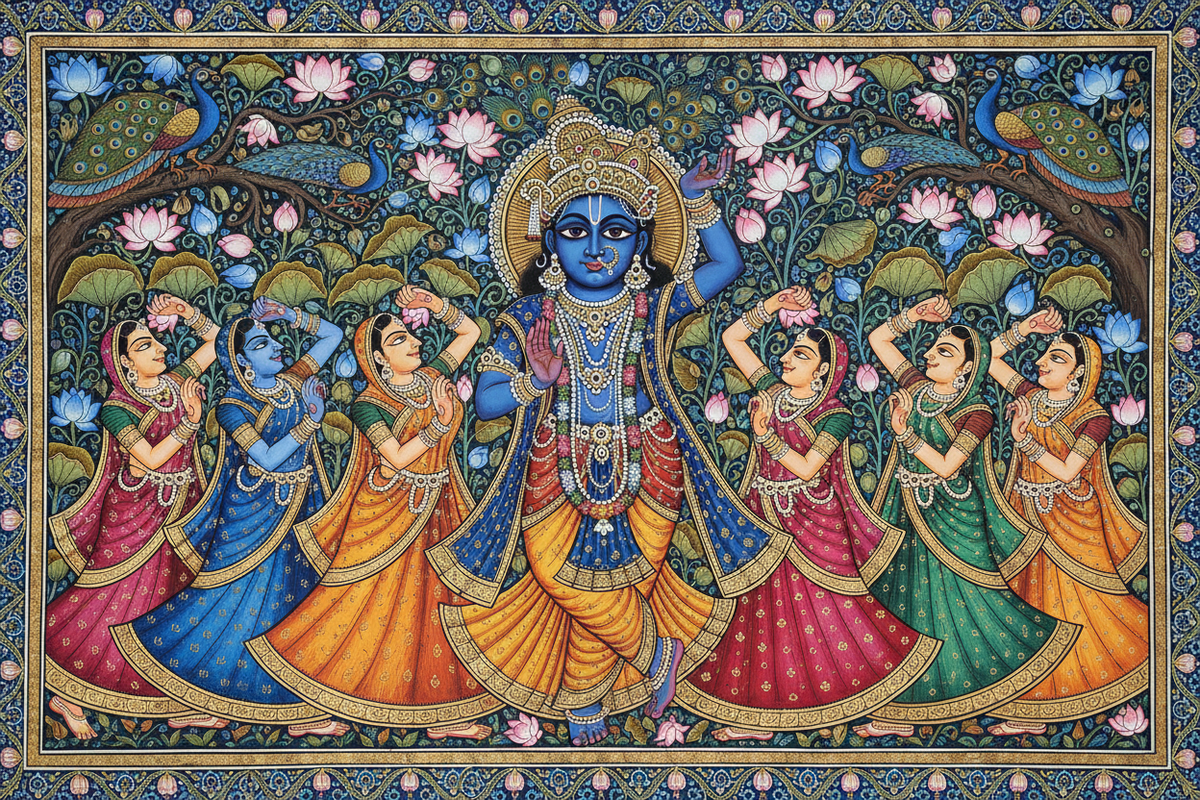
The painting depicts Lord Krishna at the center, surrounded by gopis in the vibrant circular dance. Each figure is adorned with intricate details, such as flowing garments and ornate jewelry, reflecting traditional Indian artistry. The colors are vivid and harmonious, with reds, yellows, blues, and greens dominating the palette.

Pichwai Paintings
Traditionally from Rajasthan, these artworks center Krishna in a circular dance with Gopis, adorned in flowing garments and intricate jewelry. Rich colors — red, blue, green, and yellow — highlight the joyous energy and devotion of the scene. Floral and natural motifs in the background symbolize harmony with nature and divine love.

Madhubani Motifs
Known for geometric and floral patterns, these paintings use dense backgrounds to emphasize Krishna's divine presence. Each gopi is adorned with detailed traditional attire, jewelry, and expressions of devotion, emphasizing their connection with Krishna. Lord Krishna is at the center, surrounded by gopis in a vibrant and symmetrical circular dance. This traditional Indian folk art style uses intricate patterns and bright colors such as red, blue, yellow, green, and black to create a visually striking scene.

Phad Scrolls
Large narrative scrolls from Bhilwara, Rajasthan, Phad paintings illustrate the story of Ras Lila, combining storytelling with vibrant artistry, often displayed during festivals and religious ceremonies. The term "Phad" refers to the large scrolls or cloths on which these paintings are created, often measuring several feet in length. These paintings are typically used as a storytelling medium by traveling priests or bards who would narrate the story of the gods and heroes during religious ceremonies and festivals.

Wooden Panels and Statues

This wooden panel is a beautiful and intricate form of traditional Indian wood carving art. It depicts the divine dance of Lord Krishna with Gopis. The art form takes advantage of natural textures to create detailed designs, beautifully painted with vibrant colors.
South Indian Wood Carvings
South Indian wood carvings are renowned for their precision and depth. The figures of Lord Krishna and the gopis are intricately carved, with delicate attention to their posture, expressions, and intricate garments. The carving emphasizes fluidity and grace in the portrayal of figures, so in the Ras Lila panel, the Gopis are depicted in dynamic swirling poses.
Color Symbolism
Krishna is often painted in jade green symbolizing his divine nature, while gopis are painted in vibrant colors of red, yellow, and pink, reflecting their purity, devotion, and the joy they find in Krishna's presence.

Symbolism in Ras Lila Art
| Symbol | Spiritual Meaning |
|---|---|
| Circular dance | Unity, eternity, and wholeness; the soul's journey toward enlightenment |
| Krishna's flute | The divine call drawing devotees into spiritual unity with the higher truth |
| Jade green Krishna | Divine nature, cosmic consciousness, and infinite grace |
| Gopis' vibrant colors | Purity, devotion, and the joy of surrender to the divine |
| Floral motifs | Harmony with nature and the blossoming of divine love |
Conclusion and Spiritual Significance
Ras Lila art beautifully captures the divine dance of Shri Nathji (Krishna) with the Gopis, blending devotion, love, and artistic mastery. From vibrant Pichwai paintings to intricate wooden panels, these artworks symbolize spiritual unity, eternal love, and the soul's connection with the divine. Each depiction invites viewers to reflect on bhakti, joy, and harmony, offering both aesthetic pleasure and spiritual inspiration.
FAQs
Q: What is Shri Nath Ras Lila?
The divine dance of Krishna with the Gopis, celebrated in Indian folk art and Vaishnav traditions.
Q: Which art forms depict Ras Lila?
Pichwai paintings, Phad scrolls, Madhubani motifs, and wooden panels.
Q: What does the circular dance symbolize?
Unity, eternity, wholeness, and the soul's journey toward spiritual enlightenment.
Q: Why is Krishna's flute important in Ras Lila art?
It symbolizes the divine call, attracting devotees into spiritual harmony and love.
Q: Who worships Shri Nathji?
Followers of the Pushtimarg Vaishnav sect, where Shri Nathji is considered a form of Krishna.
This article is part of Moksha Craft's Sacred Knowledge Series — handcrafted in India, delivered worldwide.

