
In this series
The Spiritual Aspect of the Sanskrit Language: Sacred Sound, Consciousness & the Divine
Summary
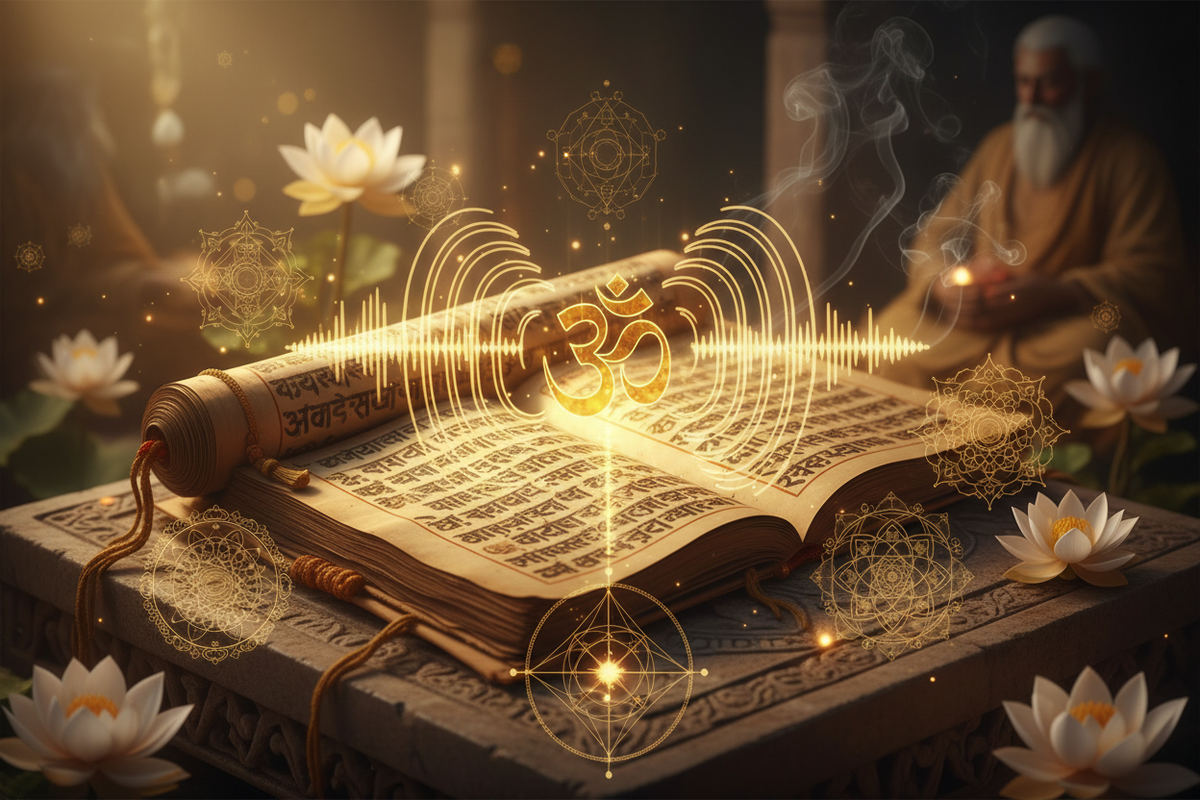
Sanskrit — the sacred language of the Hindu tradition — is far more than a means of communication. It is a precisely engineered system of sound and meaning that the Vedic tradition understands as the very language of consciousness — the medium through which the divine expresses itself in the world of form. This guide explores the spiritual dimension of Sanskrit: its relationship to the goddess Vac, the philosophy of Sanskrit grammar, and why Sanskrit mantras are considered the most spiritually potent sounds in the world.
Sanskrit as the Language of the Divine

The word Sanskrit (Samskrita) means "perfectly constructed" or "refined" — a language that has been precisely engineered to express the full range of human and divine experience with maximum clarity and minimum ambiguity. In the Vedic tradition, Sanskrit is not considered a human invention but a divine revelation — the language of the goddess Vac (speech), who is the divine power of expression through which Brahman (the ultimate reality) manifests as the world.
The Goddess Vac: The Divine Power of Speech
In the Rigveda, the goddess Vac declares: "I am the queen, the gatherer of treasures, the most thoughtful, the first of those worthy of worship. The gods have established me in many places; I have many homes and enter many forms." (Rigveda 10.125) Vac is the divine power of speech and language — the creative force through which the divine expresses itself in the world. Sanskrit, as the language of Vac, is understood as the most direct human access to this divine creative power.
The Philosophy of Sanskrit Grammar
| Concept | Philosopher | Teaching |
|---|---|---|
| Aum (Om) | Vedic tradition | The primordial sound from which all of Sanskrit — and all of existence — emerges; the sound of Brahman |
| Sphota theory | Bhartrhari (5th century CE) | The meaning of a word is not in its individual sounds but in the whole — the sphota — that flashes in the mind when the word is heard; language and consciousness are inseparable |
| Vakyapadiya | Bhartrhari | "On Sentences and Words" — the most sophisticated philosophy of language in the Sanskrit tradition; argues that Brahman itself is of the nature of language (Shabda Brahman) |
| Mahabhashya | Patanjali (2nd century BCE) | The great commentary on Panini's grammar; establishes Sanskrit grammar as a spiritual discipline that purifies the mind and leads to liberation |
Why Sanskrit Mantras Are Spiritually Potent
Sanskrit mantras are not merely meaningful phrases — they are precise vibrational formulas that work through the power of sound itself. The Vedic tradition teaches that each Sanskrit phoneme (sound unit) has a specific vibrational quality that affects consciousness in a precise way. When a mantra is chanted correctly — with proper pronunciation, rhythm, and intention — it creates specific effects in the mind and environment by aligning the practitioner's consciousness with the divine reality that the mantra invokes.
- Om — the primordial sound; the vibration of Brahman itself
- Om Namah Shivaya — the five-syllable mantra of Shiva; each syllable corresponds to one of the five elements
- Om Namo Narayanaya — the eight-syllable mantra of Vishnu; the most powerful Vaishnava mantra
- Om Gam Ganapataye Namaha — the seed mantra of Ganesha; removes obstacles at the vibrational level
Conclusion
Sanskrit is not merely an ancient language — it is a living spiritual technology, a precisely engineered system of sacred sound that the Vedic tradition has used for thousands of years to access, express, and transmit the highest dimensions of human and divine experience. To study Sanskrit, to chant Sanskrit mantras, or simply to appreciate the extraordinary beauty and precision of this sacred language is to connect with one of humanity's greatest spiritual achievements — and with the divine creative power that it embodies.
"Aum — the imperishable Brahman is all this. All that is past, present, and future is indeed Aum." (Mandukya Upanishad 1.1)
This article is part of Moksha Craft's Sacred Knowledge Series — handcrafted in India, delivered worldwide.

