
In this series
Laughing Buddha: Which One to Use and Where to Place for Maximum Luck & Prosperity
Summary
The Laughing Buddha — known in Chinese as Budai (or Hotei in Japanese) — is one of the most beloved and widely recognized sacred figures in East Asian culture. With his enormous belly, joyful smile, and sack of treasures, the Laughing Buddha is a symbol of happiness, abundance, and good fortune that has found a home in millions of households, businesses, and gardens around the world. This guide helps you choose the right Laughing Buddha and place it correctly for maximum benefit.
Who is the Laughing Buddha?

The Laughing Buddha is based on Budai — a beloved Chinese Zen monk who lived in the 10th century CE and was known for his joyful, generous nature and his large cloth sack (from which his name comes: bu = cloth, dai = bag). In Chinese Buddhist tradition, Budai is considered an incarnation of Maitreya — the future Buddha. He is not the historical Shakyamuni Buddha, but a distinct figure representing the joy, abundance, and contentment of an enlightened mind.
Types of Laughing Buddha and Their Meanings
| Type | What He Holds/Features | Blessing |
|---|---|---|
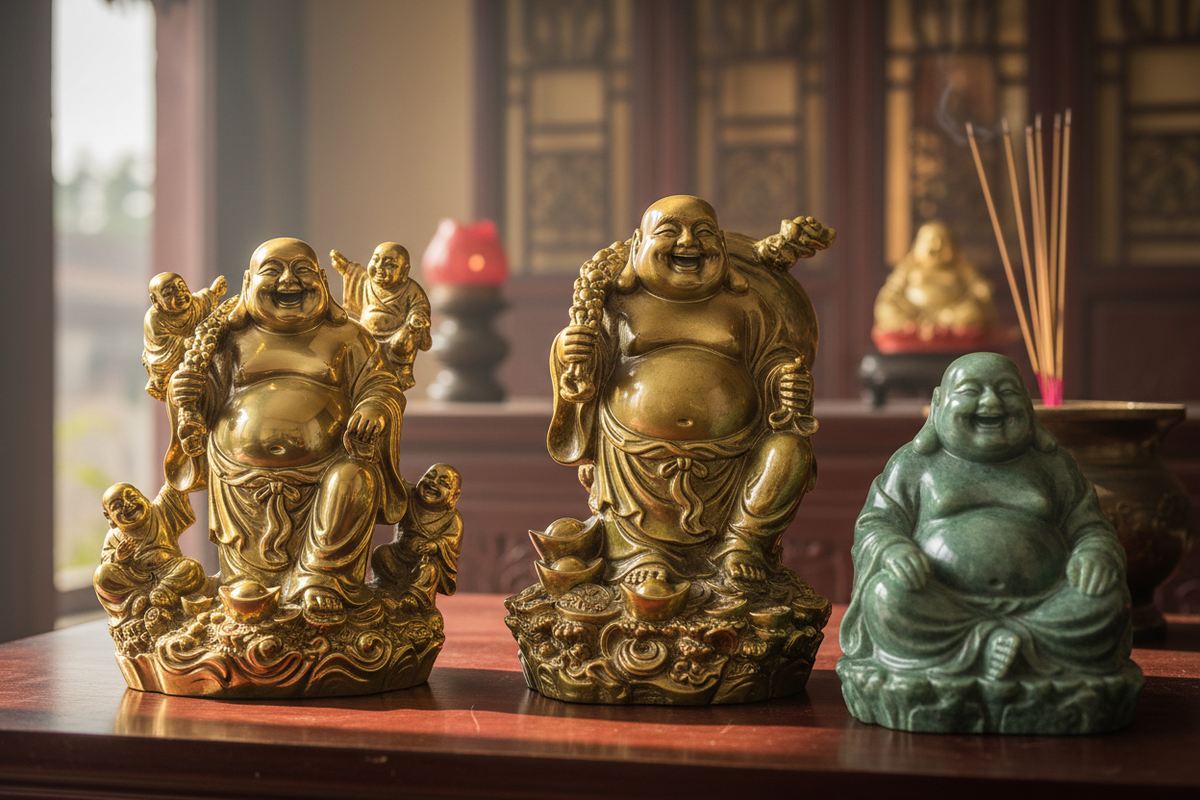
| With children | Surrounded by happy children | Fertility, family happiness, blessings for children |
| With gold ingots | Holding or surrounded by gold ingots (yuanbao) | Wealth, financial prosperity, business success |
| With fan | Holding a fan | Joy, happiness, warding off evil |
| With beads/mala | Holding prayer beads | Meditation, spiritual practice, inner peace |
| With sack | Carrying a large cloth sack | Abundance, good luck, carrying away troubles |
| With bowl | Holding a bowl | Receiving blessings; spiritual abundance |
| Meditating | Seated in meditation | Inner peace, wisdom, spiritual development |
| With Wu Lou (gourd) | Holding a gourd | Health, longevity, healing |
Best Materials for Laughing Buddha
| Material | Quality | Best For |
|---|---|---|
| Brass / Bronze | Durable, traditional, conducts positive energy | Home mandir, living room, office |
| Jade / Green stone | Most auspicious in Chinese tradition; attracts wealth | Business, wealth corner, office |
| Wood | Natural, warm, grounding | Home interiors, garden |
Placement Guide: Dos and Don'ts
| Do | Don't |
|---|---|
| Place at eye level or above | Never place on the floor |
| Place facing the main entrance | Never place in the bathroom or kitchen |
| Place in the southeast corner for wealth (Feng Shui) | Never place facing a wall |
| Rub his belly for good luck! | Never place in the bedroom |
| Keep clean and dust-free | Never place under stairs |
Conclusion
The Laughing Buddha is one of the most joyful and accessible sacred figures in the world — a reminder that abundance, happiness, and good fortune are not distant ideals but present possibilities, available to anyone who approaches life with the same open-hearted generosity and contentment that Budai embodied. Choose the form that resonates with your intention, place it with care, and let his infectious joy transform your home into a space of abundance and delight.
Explore Moksha Craft's collection of handcrafted Laughing Buddha statues — made in India, delivered worldwide.

