
In this series
A Lesson on Morality in Hindu Mythology: 7 Timeless Teachings from Indian Stories
Summary
Hindu mythology is not merely a collection of entertaining stories — it is a vast treasury of moral and ethical wisdom, encoded in narratives of extraordinary beauty and power. The stories of the gods, heroes, and sages of the Hindu tradition are designed to teach, inspire, and guide human beings toward a life of dharma (righteousness), compassion, and wisdom. This guide presents 7 of the most important moral lessons from Hindu mythology.
7 Timeless Moral Lessons from Hindu Mythology

| # | Lesson | Story | Teaching |
|---|---|---|---|
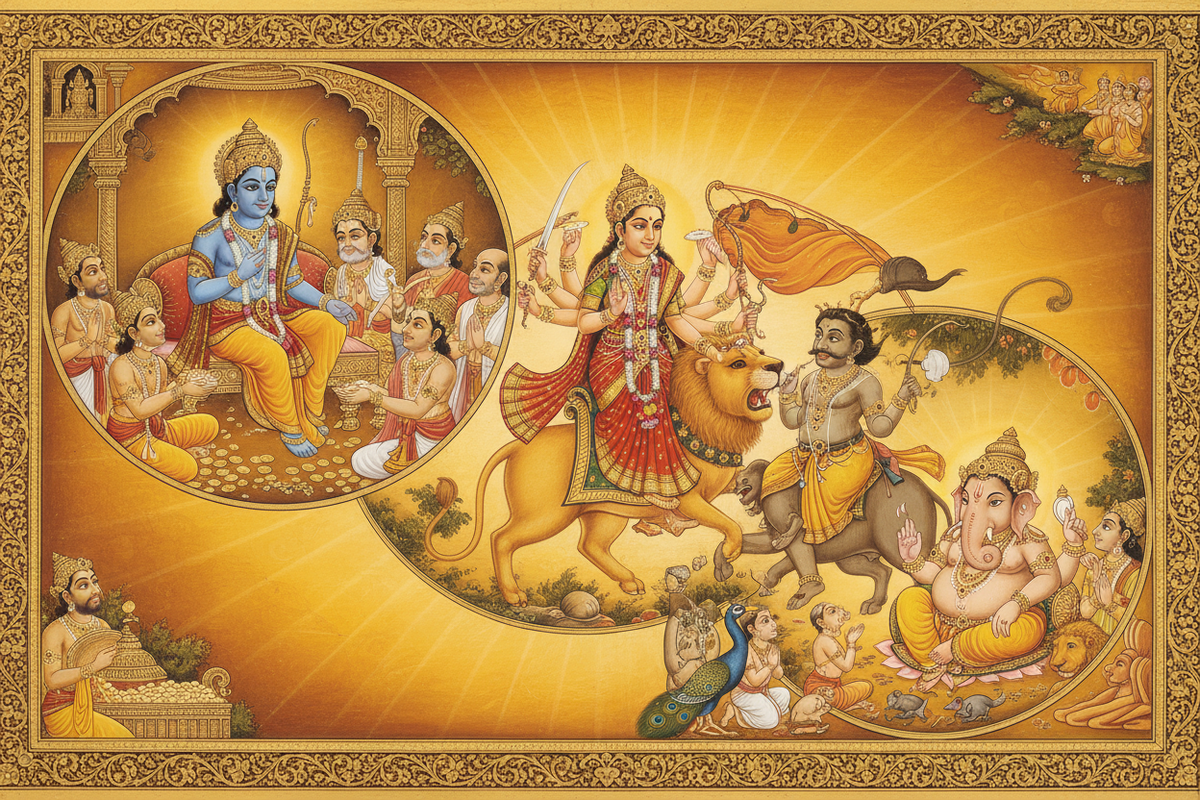
| 1 | Friendship | Lord Rama and Sugriva | True friendship transcends social boundaries; Rama befriended the monkey king Sugriva and honored his commitment even at great personal cost |
| 2 | Humility | Ganesha and Lord Kubera | No amount of wealth can satisfy an arrogant heart; Kubera's pride was humbled when Ganesha ate all his food and still demanded more |
| 3 | Hard Work | Drona and the Pandavas | Excellence is the fruit of dedicated practice; Drona's rigorous training transformed the Pandavas into the greatest warriors of their age |
| 4 | Courage | Goddess Durga and Mahishasura | Evil must be confronted with courage and divine power; Durga's victory over the buffalo demon shows that righteousness always prevails |
| 5 | Honesty | The Potter's Story | A single lie requires a thousand more to sustain it; honesty, however difficult, is always the foundation of a good life |
| 6 | Mercy | Mandodari and Vibhishana | Compassion and righteousness must guide our actions even in the midst of conflict; Vibhishana's mercy toward Rama's cause was ultimately rewarded |
| 7 | Hope | Sita in Exile | Faith and inner strength sustain us through the darkest trials; Sita's unwavering devotion and hope during her captivity is the model of spiritual resilience |
Courage: Goddess Durga and Mahishasura

The story of Goddess Durga's victory over the buffalo demon Mahishasura is one of the most powerful moral narratives in Hindu mythology. When the gods were defeated by Mahishasura's seemingly invincible power, they combined their divine energies to create Durga — the supreme goddess of power and righteousness. Armed with the weapons of all the gods, Durga fought Mahishasura for nine days and nights and finally defeated him on the tenth day (Vijayadashami). The lesson: when individual strength fails, collective righteousness prevails; and the divine feminine power (Shakti) is the ultimate force that restores cosmic order.
Humility: Ganesha and Lord Kubera
Lord Kubera — the god of wealth — once invited Lord Shiva and Parvati to a grand feast, motivated more by pride in his wealth than by genuine devotion. Shiva sent the child Ganesha in his place. Ganesha ate everything at the feast and still demanded more — and when Kubera could provide no more, Ganesha began eating the furniture, the palace, and finally Kubera himself. Only when Kubera prostrated himself before Shiva and Parvati in genuine humility did Ganesha's hunger cease. The lesson: wealth without humility is a curse; true abundance flows from a humble and grateful heart.
Conclusion
The moral lessons of Hindu mythology are not abstract principles — they are living teachings, encoded in stories of extraordinary power and beauty, designed to be remembered, retold, and applied in daily life. Whether you draw inspiration from Rama's friendship, Durga's courage, or Sita's hope, these stories offer a complete guide to the ethical life — a life lived in alignment with dharma, compassion, and the divine.
This article is part of Moksha Craft's Sacred Knowledge Series — handcrafted in India, delivered worldwide.

