
In this series
What is the Purpose of a Thangka? Tibetan Buddhist Sacred Art Explained
Summary
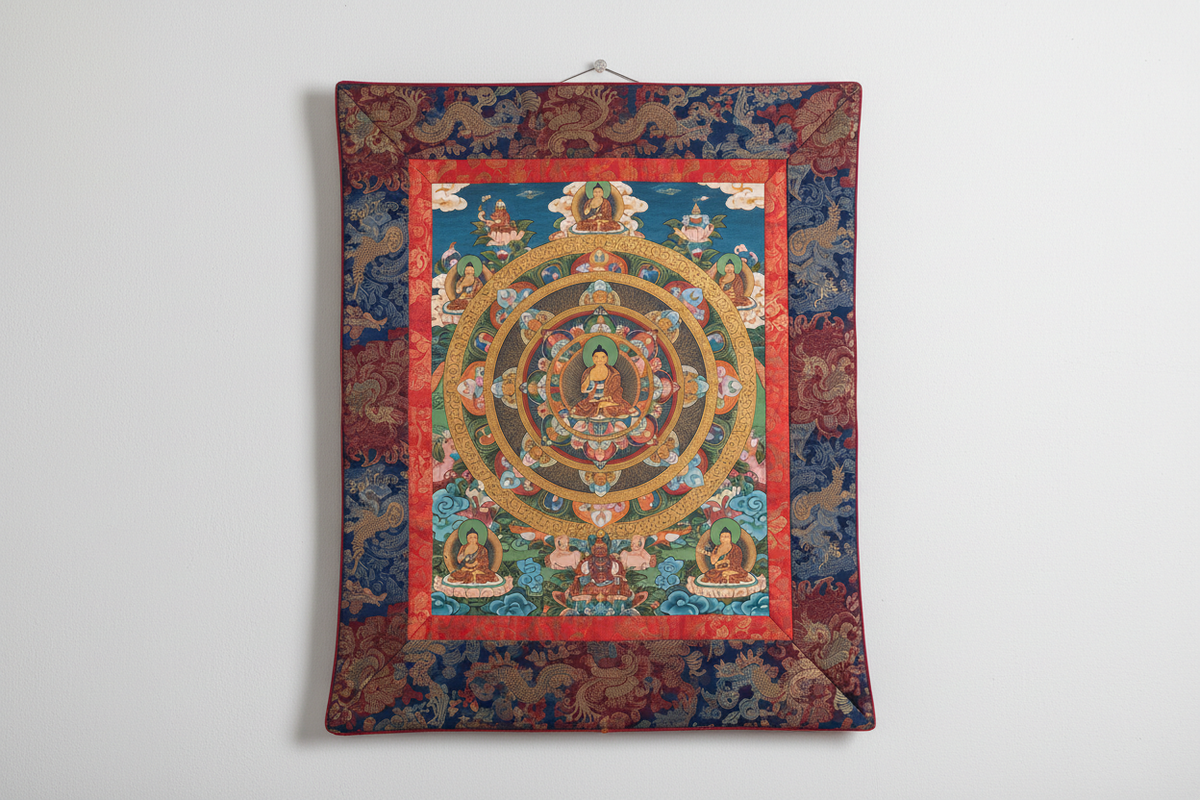
A Thangka is a traditional Tibetan Buddhist painting on silk or cotton — one of the most sophisticated and spiritually potent forms of sacred art in the world. Created by trained artists following precise iconographic guidelines, consecrated by monks, and used for meditation, teaching, and ritual, a Thangka is far more than a decorative object: it is a sacred tool for spiritual practice and a window into the Tibetan Buddhist understanding of reality.
What is a Thangka?

The word Thangka comes from the Tibetan, meaning "the thing that one unrolls" — referring to the traditional practice of rolling and storing these paintings when not in use. Thangkas depict deities, mandalas, sacred scenes from the Buddha's life, or complex cosmological diagrams, and range in size from small personal practice pieces (around 50 cm) to enormous monastery display pieces that can cover entire building facades.
The Three Purposes of a Thangka
| Purpose | How It Works |
|---|---|
| Meditation and visualization | Practitioners use Thangkas as objects of focused meditation, visualizing the depicted deity as a living presence and eventually internalizing the deity's qualities |
| Religious teaching and storytelling | Thangkas depicting the Buddha's life, the Wheel of Life, or the lives of great masters serve as visual teaching tools for monks and laypeople |
| Sacred ritual and ceremony | Thangkas are displayed during religious festivals, used in initiation ceremonies, and hung in temples and monasteries as objects of veneration |
The Artistic Process

Creating a Thangka is a sacred act that can take anywhere from one to four months for a skilled artist. The process follows precise traditional guidelines:
- Canvas preparation — cotton or silk is stretched on a frame and coated with chalk and glue
- Sacred geometry — the composition is laid out using precise geometric proportions from the iconographic texts
- Sketching — the deity or scene is drawn in pencil following the canonical proportions
- Painting — natural mineral pigments (lapis lazuli, malachite, cinnabar) are applied in layers
- Gold work — pure gold is applied for halos, ornaments, and sacred details
- Consecration — the completed Thangka is consecrated by a qualified monk or lama
Types of Thangka Paintings
| Type | Description |
|---|---|
| Cotton Thangka | Most common; painted on prepared cotton canvas with mineral pigments |
| Silk Thangka | Painted on silk; more delicate and luminous |
| Applique Thangka | Made from cut and sewn silk pieces; used for large monastery display pieces |
| Gold Background | Deity painted on pure gold background; most precious and auspicious |
| Black Background | Used for wrathful deities; powerful and dramatic |
| Red Background | Used for specific deities; symbolizes energy and compassion |
How to Display a Thangka at Home
- Choose a clean, respectful space — a meditation room, study, or living room altar
- Frame it for protection while preserving the traditional silk brocade border
- Ensure good lighting — natural or warm artificial light brings out the pigments
- Avoid direct sunlight — UV light fades natural pigments over time
- When not displayed, roll carefully and store in a cool, dry place
Conclusion
A Thangka is one of the most extraordinary objects in the world of sacred art — a painting that is simultaneously a work of art, a meditation tool, a teaching device, and a sacred presence. Whether you are a Buddhist practitioner using it for meditation or an art lover drawn to its extraordinary beauty, a Thangka brings the wisdom and compassion of the Tibetan Buddhist tradition into your home in the most tangible and beautiful form possible.
Explore Moksha Craft's collection of authentic Thangka paintings — made in India and Nepal, delivered worldwide.
