
In this series
Vat Savitri Vrat: The Sacred Festival of Matrimonial Devotion — Significance, Rituals & Story
Summary
Vat Savitri Vrat is one of the most sacred festivals observed by married Hindu women — a day of fasting, prayer, and devotion at the banyan tree, dedicated to the wellbeing and long life of their husbands. Rooted in the legendary story of Savitri, who outwitted Yama (the god of death) to bring her husband Satyavan back to life, this festival celebrates the power of a wife's love, devotion, and spiritual strength.
The Legend of Savitri and Satyavan
The Vat Savitri Vrat is rooted in one of the most beloved stories of the Mahabharata — the tale of Savitri, a princess of extraordinary virtue and intelligence, and Satyavan, a prince living in exile in the forest whose death had been foretold by the divine sage Narada.
Knowing that Satyavan was destined to die within a year, Savitri chose him as her husband anyway — declaring that she would love only once and that her heart had already chosen. When the fateful day arrived and Yama came to claim Satyavan's soul, Savitri followed the god of death, refusing to turn back. Through her unwavering devotion, her profound wisdom, and her skillful words, she won boon after boon from Yama — until finally she won back Satyavan's life itself.
The banyan tree (Vat Vriksha) under which Satyavan died and was restored to life became the sacred symbol of this festival — a tree that itself symbolizes immortality, with its aerial roots that descend to become new trunks, representing the eternal cycle of life.
When is Vat Savitri Vrat Observed?
| Region | Date | Lunar Day |
|---|---|---|
| North India | Jyeshtha Amavasya (new moon) | No-moon day of Jyeshtha month (May–June) |
| South India / Maharashtra / Gujarat | Jyeshtha Purnima (full moon) | Full moon day of Jyeshtha month |
Rituals of Vat Savitri Vrat

Step-by-Step Ritual Guide
| Step | Ritual | Significance |
|---|---|---|
| 1 | Bathe early and wear new or clean clothes, preferably red or yellow | Purity and auspiciousness |
| 2 | Fast for the entire day (some observe a three-day fast) | Tapas (austerity) that generates spiritual power |
| 3 | Visit a banyan tree and clean the area around it | Honouring the sacred Vat Vriksha |
| 4 | Offer water, flowers, fruits, sindoor, and sweets to the banyan tree | Worship of the tree as a symbol of immortality |
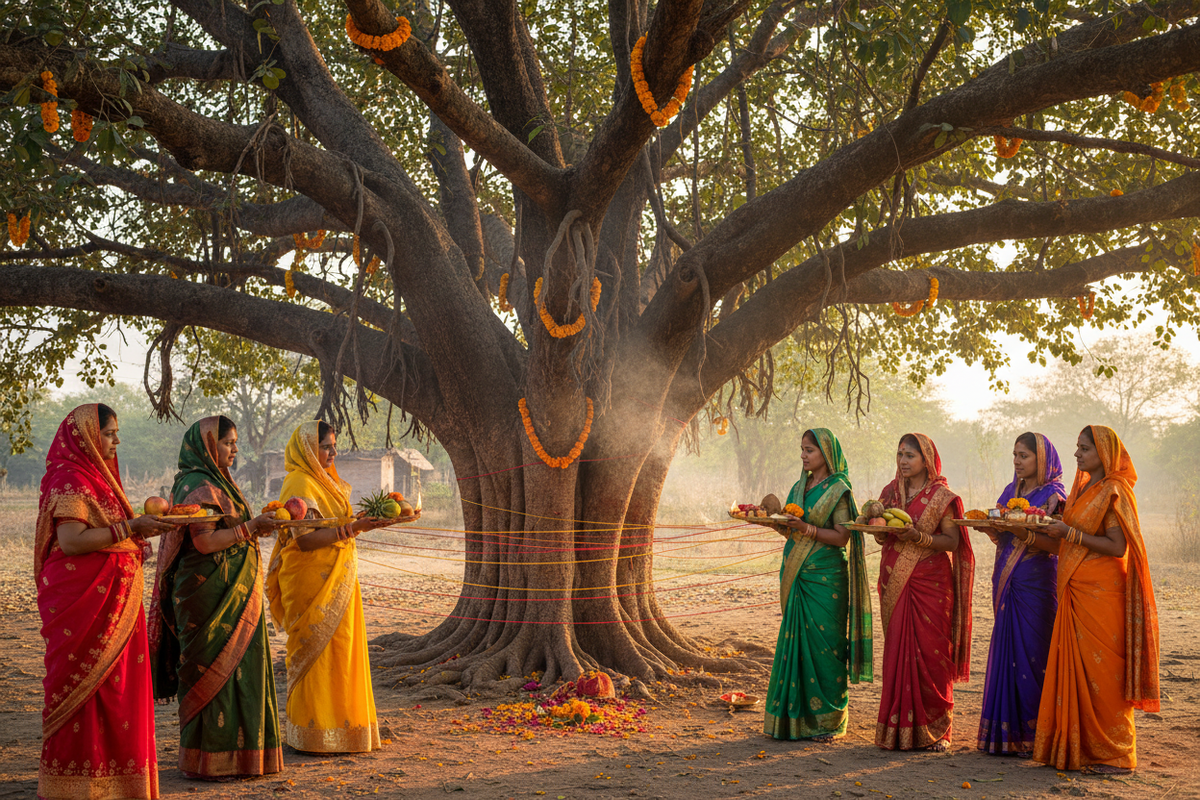
| 5 | Tie a sacred red or yellow thread around the banyan tree while circumambulating it 108 times (or 7 times) | Binding the husband's life force to the eternal tree |
| 6 | Listen to or recite the story of Savitri and Satyavan | Invoking the power of Savitri's devotion |
| 7 | Pray to Savitri, Satyavan, and Yama for the husband's long life and health | Direct petition to the divine |
| 8 | Break the fast after sunset with a sattvic meal | Completion of the vrat |
Spiritual Significance
Vat Savitri Vrat is far more than a ritual for a husband's longevity — it is a celebration of the power of Pativrata Dharma (the sacred duty of a devoted wife) and a reminder that true love, combined with spiritual strength and wisdom, can overcome even death itself. Savitri's story is not one of passive devotion but of active, intelligent, courageous love — she argued with Yama, outwitted him with her words, and won through the sheer force of her virtue.
The banyan tree, with its immortal roots and ever-expanding canopy, is the perfect symbol for this festival — representing the eternal, unbreakable bond of marriage and the life-giving power of devoted love.
Conclusion
Vat Savitri Vrat is a living testament to the power of devotion, wisdom, and love. In the story of Savitri, Hindu tradition offers not a passive ideal of wifely submission but a dynamic model of spiritual courage — a woman who faced death itself and won. On this sacred day, married women across India renew their commitment to their husbands and to the eternal values of love, loyalty, and spiritual strength.
This article is part of Moksha Craft's Sacred Knowledge Series — handcrafted in India, delivered worldwide.

