
In this series
The Trimurti of Hinduism: Brahma, Vishnu & Shiva — The Sacred Hindu Trinity Explained
Summary
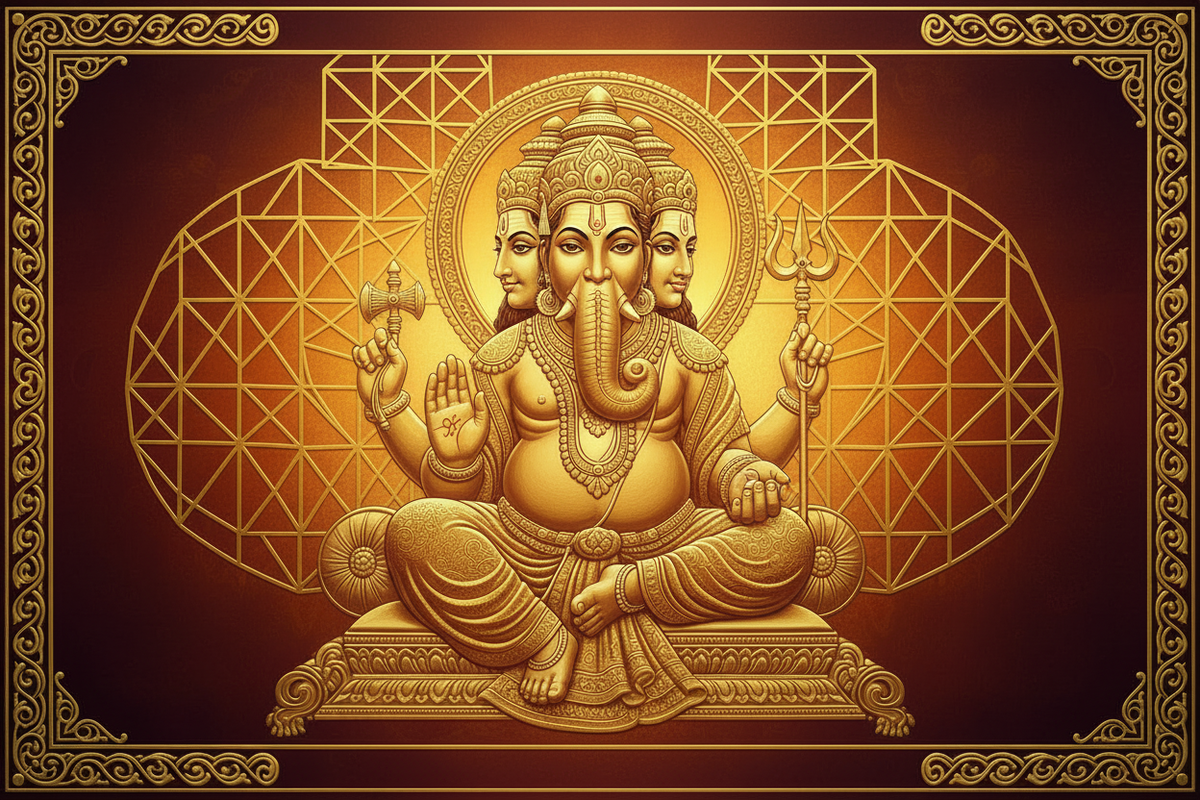
The Trimurti is the sacred Hindu Trinity — the three cosmic forces of Creation (Brahma), Preservation (Vishnu), and Dissolution (Shiva) that together govern the eternal cycle of the universe. Far from being three separate gods, the Trimurti represents three aspects of the one supreme reality (Brahman) — the three faces of the divine that sustain all existence. This guide explores the iconography, cosmic roles, and spiritual significance of each member of the Trimurti.
Lord Brahma — The Creator

Lord Brahma is the first member of the Trimurti — the divine force of creation who brought the universe into existence. He is depicted with four faces (representing the four Vedas and the four directions) and four arms holding the Vedas, a kamandal (water pot), a scepter, and a lotus. His vehicle is the Hamsa (swan) — a symbol of wisdom and discrimination.
Brahma is associated with Saraswati (the goddess of knowledge) and is said to have created the universe from the primordial waters, using the sacred syllable Om as the seed of all creation. Despite his cosmic importance, Brahma has relatively few temples dedicated to him — the most famous being the Brahma Temple at Pushkar, Rajasthan.
Lord Vishnu — The Preserver
Lord Vishnu is the second member of the Trimurti — the divine force of preservation who maintains cosmic order (Dharma) and protects the universe from chaos. He is depicted with four arms holding the Shankha (conch), Sudarshan Chakra (discus), Gada (mace), and Padma (lotus). His vehicle is Garuda (the divine eagle), and he rests on the cosmic serpent Shesha on the primordial ocean.
Vishnu is known for his ten principal avatars (Dashavatara) who descend to earth whenever Dharma is threatened — most famously as Rama and Krishna. Vaishnavism, centered on the worship of Vishnu, is the largest tradition within Hinduism.
Lord Shiva — The Destroyer
Lord Shiva is the third member of the Trimurti — the divine force of dissolution who destroys the old universe at the end of each cosmic cycle to make way for new creation. He is depicted as an ascetic with matted hair, a crescent moon, the river Ganga flowing from his locks, a serpent around his neck, and the sacred Trishul (trident) in his hand.
Shiva's most celebrated form is Nataraja — the cosmic dancer whose Tandava dance sustains the rhythm of the universe. He is also worshipped as the Shiva Lingam — the formless pillar of light that represents his infinite, transcendent nature.
The Trimurti as One: Lord Dattatreya

The unity of the Trimurti is most beautifully expressed in the form of Lord Dattatreya — a deity with three faces (Brahma, Vishnu, and Shiva) and six arms holding the symbols of all three. Dattatreya represents the philosophical truth that Creation, Preservation, and Dissolution are not three separate forces but three aspects of the one supreme reality.
The Cosmic Roles of the Trimurti
| Deity | Role | Quality | Consort | Vehicle |
|---|---|---|---|---|
| Brahma | Creator | Rajas (activity) | Saraswati | Hamsa (swan) |
| Vishnu | Preserver | Sattva (purity) | Lakshmi | Garuda (eagle) |
| Shiva | Destroyer / Transformer | Tamas (inertia) | Parvati | Nandi (bull) |
Conclusion
The Trimurti is one of Hinduism's most profound philosophical concepts — the recognition that the universe is sustained by three eternal forces that are ultimately one. Creation, preservation, and dissolution are not opposites but partners in the eternal dance of existence. To understand the Trimurti is to understand the fundamental rhythm of the cosmos itself.
This article is part of Moksha Craft's Sacred Knowledge Series — handcrafted in India, delivered worldwide.

