In this series
The Life of Vardhamana Mahavira: 24th Tirthankara of Jainism
Summary
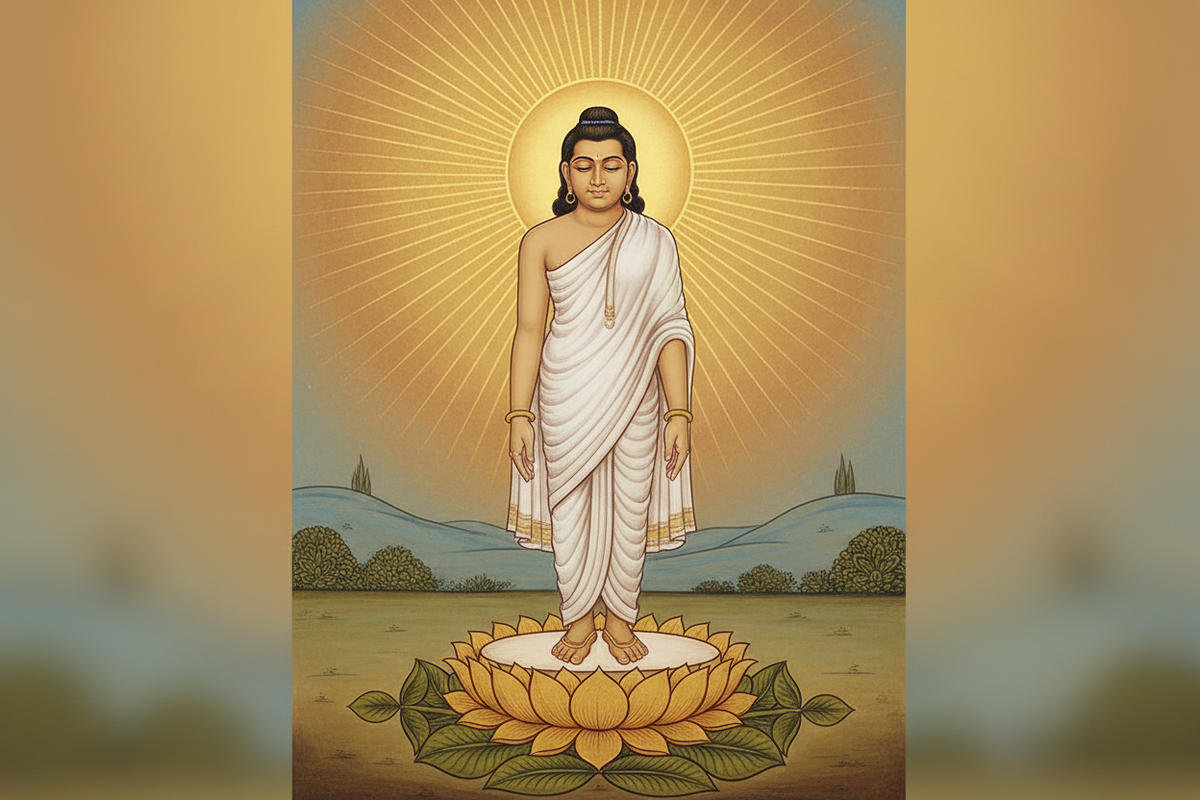
Vardhamana Mahavira (599–527 BCE) is the 24th and last Tirthankara (ford-maker) of Jainism — the great spiritual teacher who revitalized and systematized the Jain tradition in the 6th century BCE, contemporaneous with the Buddha. His life of extraordinary renunciation, his attainment of Kevala Jnana (omniscience), and his teaching of the five great vows have shaped Jain philosophy and practice for over 2,500 years.
The Life of Mahavira

| Event | Details |
|---|---|
| Birth | Born in 599 BCE in Vaishali (modern Bihar); son of King Siddhartha and Queen Trishala of the Ikshvaku dynasty |
| Early life | Named Vardhamana ("one who grows"); raised in royal luxury; married Yashoda; had a daughter, Priyadarshana |
| Renunciation | At age 30, renounced his royal life; performed the Panchmushthi Loch (pulling out his hair in five handfuls); became a wandering ascetic |
| Asceticism | Practiced extreme austerities for 12 years; endured heat, cold, insects, and abuse without complaint; maintained complete silence |
| Kevala Jnana | At age 42, attained Kevala Jnana (omniscience) under a Sal tree on the banks of the Rijupalika river |
| Teaching | Spent 30 years teaching the Jain Dharma; gathered a large community of monks, nuns, laymen, and laywomen |
| Nirvana | Attained Moksha (liberation) at age 72 at Pavapuri, Bihar; the night of his liberation is celebrated as Diwali by Jains |
The Five Great Vows (Pancha Mahavrata)
| # | Vow | Sanskrit | Meaning |
|---|---|---|---|
| 1 | Non-violence | Ahimsa | Complete non-harm to all living beings in thought, word, and deed |
| 2 | Truthfulness | Satya | Speaking only what is true, beneficial, and kind |
| 3 | Non-stealing | Asteya | Taking only what is freely given |
| 4 | Celibacy | Brahmacharya | Complete celibacy for monks; fidelity for laypeople |
| 5 | Non-attachment | Aparigraha | Freedom from possessiveness and attachment to material things |
Mahavira's Core Teachings
- Ahimsa Paramo Dharma — "Non-violence is the highest dharma"; the central principle of Jainism
- Anekantavada — the doctrine of many-sidedness; truth has multiple aspects and no single perspective captures the whole
- Syadvada — the doctrine of conditional predication; all statements are true only from a particular perspective
- Karma — in Jainism, karma is understood as actual physical particles that attach to the soul through action, thought, and speech
- Liberation (Moksha) — achieved by shedding all karma through right knowledge, right faith, and right conduct
Conclusion
Vardhamana Mahavira is one of the most extraordinary spiritual figures in Indian history — a man who renounced a kingdom, endured 12 years of extreme austerity, attained omniscience, and spent 30 years teaching a path of radical non-violence and liberation that has inspired millions of followers for over 2,500 years. His central teaching — Ahimsa Paramo Dharma (non-violence is the highest dharma) — remains one of the most powerful and relevant ethical principles in the world today.
This article is part of Moksha Craft's Sacred Knowledge Series — handcrafted in India, delivered worldwide.